Friday, 29 January 2021

Quantum Numbers (Principal, Azimuthal, Magnetic & Spin) - Definition, Detailed Explanation with Videos

Table of Contents

What are Quantum NumbersRecommended VideosPrincipal Quantum NumberAzimuthal Quantum NumberMagnetic Quantum NumberElectron Spin Quantum NumberSummary

Quantum numbers can be used to describe the trajectory and the movement of an electron in an atom. The quantum numbers of all the electrons in a given atom, when combined, must comply with the Schrodinger equation.

What are Quantum Numbers?

The set of numbers used to describe the position and energy of the electron in an atom are called quantum numbers. There are four quantum numbers, namely, principal, azimuthal, magnetic and spin quantum numbers.

The values of the conserved quantities of a quantum system are given by quantum numbers. Electronic quantum numbers (the quantum numbers describing electrons) can be defined as a group of numerical values which provide solutions that are acceptable by the Schrodinger wave equation for hydrogen atoms.
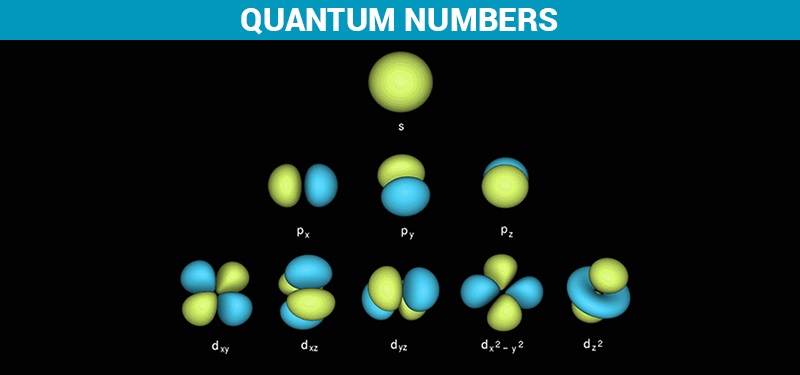
Quantum Numbers

Quantum Numbers and Atomic Orbitals

Four quantum numbers can be used to completely describe all the attributes of a given electron belonging to an atom, these are:

  • Principal quantum number, denoted by n.
  • Orbital angular momentum quantum number (or azimuthal quantum number), denoted by l.
  • Magnetic quantum number, denoted by ml.
  • The electron spin quantum number, denoted by ms.
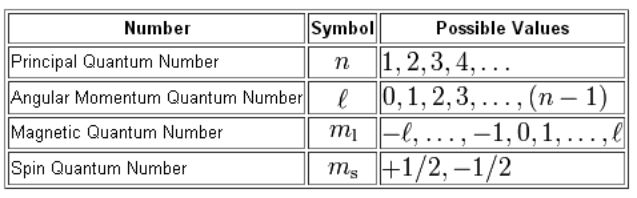
Electronic Quantum Numbers

The Four Quantum Numbers that Describe an Electron

Recommended Videos


When the characteristics of an electron must be described in compliance with the Schrodinger wave equation, a total of four quantum numbers are used. A brief description of each of these numbers in the set of four quantum numbers that describe the unique quantum state of an electron in atomic physics can be found below.

Principal Quantum Number

  • Principal quantum numbers are denoted by the symbol ‘n’. They designate the principal electron shell of the atom. Since the most probable distance between the nucleus and the electrons is described by it, a larger value of the principal quantum number implies a greater distance between the electron and the nucleus (which, in turn, implies a greater atomic size).
  • The value of the principal quantum number can be any integer with a positive value that is equal to or greater than one. The value n=1 denotes the innermost electron shell of an atom, which corresponds to the lowest energy state (or the ground state) of an electron.
  • Thus, it can be understood that the principal quantum number, n, cannot have a negative value or be equal to zero because it is not possible for an atom to have a negative value or no value for a principal shell.
  • When a given electron is infused with energy (excited state), it can be observed that the electron jumps from one principle shell to a higher shell, causing an increase in the value of n. Similarly, when electrons lose energy, they jump back into lower shells and the value of n also decreases.
  • The increase in the value of n for an electron is called absorption, emphasizing the photons or energy being absorbed by the electron. Similarly, the decrease in the value of n for an electron is called emission, where the electrons emit their energy.

Azimuthal Quantum Number (Orbital Angular Momentum Quantum Number)

  • The azimuthal (or orbital angular momentum) quantum number describes the shape of a given orbital. It is denoted by the symbol ‘l’ and its value is equal to the total number of angular nodes in the orbital.
  • A value of the azimuthal quantum number can indicate either an s, p, d, or f subshell which vary in shapes. This value depends on (and is capped by) the value of the principal quantum number, i.e. the value of the azimuthal quantum number ranges between 0 and (n-1).
  • For example, if n =3, the azimuthal quantum number can take on the following values – 0,1, and 2. When l=0, the resulting subshell is an ‘s’ subshell. Similarly, when l=1 and l=2, the resulting subshells are ‘p’ and ‘d’ subshells (respectively). Therefore, when n=3, the three possible subshells are 3s, 3p, and 3d.
  • In another example where the value of n is 5, the possible values of l are 0, 1, 2, 3, and 4. If l = 3, then there are a total of three angular nodes in the atom.
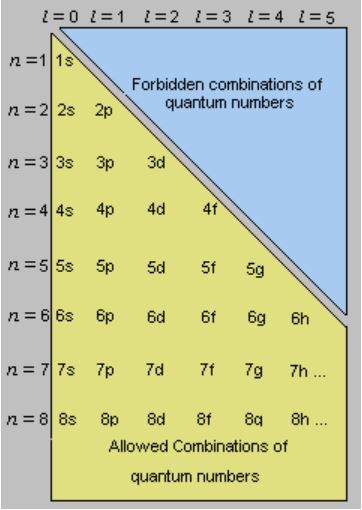
    Combinations of the Principal and Azimuthal Quantum Numbers

    Combinations of the Principal and Azimuthal Quantum Numbers

The allowed subshells under different combinations of ‘n’ and ‘l’ are listed above. It can be understood that the ‘2d’ orbital cannot exist since the value of ‘l’ is always less than that of ‘n’.

Magnetic Quantum Number

The total number of orbitals in a subshell and the orientation of these orbitals are determined by the magnetic quantum number. It is denoted by the symbol ‘ml’. This number yields the projection of the angular momentum corresponding to the orbital along a given axis.
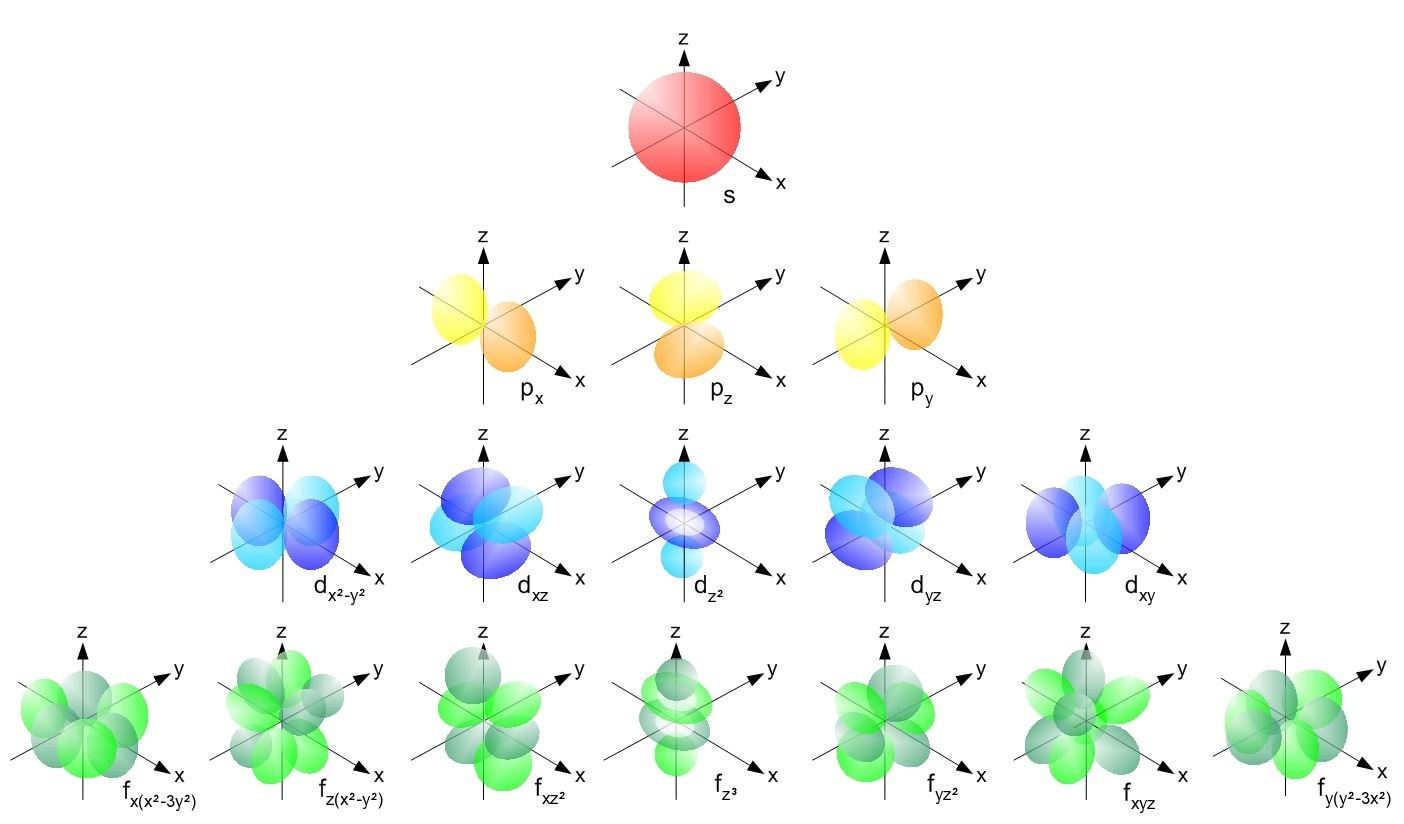
Orbitals as per Quantum Numbers

Shapes of Orbitals (as per the corresponding Quantum Numbers)

The value of the magnetic quantum number is dependant on the value of the azimuthal (or orbital angular momentum) quantum number. For a given value of l, the value of ml ranges between the interval -l to +l. Therefore, it indirectly depends on the value of n.

For example, if n = 4 and l = 3 in an atom, the possible values of the magnetic quantum number are -3, -2, -1, 0, +1, +2, and +3.

Azimuthal Quantum Number ValueCorresponding Number of Orbitals (2l + 1)Possible Values of ml
0 (‘s’ subshell)2*0 + 1 = 10
1 (‘p’ subshell)2*1 + 1 = 3-1, 0, and 1
2 (‘d’ subshell)2*2 + 1 = 5-2, -1, 0, 1, and 2
3 (‘f’ subshell)2*3 + 1 = 7-3, -2, -1, 0, 1, 2, and 3

The total number of orbitals in a given subshell is a function of the ‘l’ value of that orbital. It is given by the formula (2l + 1). For example, the ‘3d’ subshell (n=3, l=2) contains 5 orbitals (2*2 + 1). Each orbital can accommodate 2 electrons. Therefore, the 3d subshell can hold a total of 10 electrons.

Electron Spin Quantum Number

  • The electron spin quantum number is independent of the values of n, l, and ml. The value of this number gives insight into the direction in which the electron is spinning, and is denoted by the symbol ms.
  • The value of ms offers insight into the direction in which the electron is spinning. The possible values of the electron spin quantum number are +½ and -½.
  • The positive value of ms implies an upward spin on the electron which is also called ‘spin up’ and is denoted by the symbol ↑. If ms has a negative value, the electron in question is said to have a downward spin, or a ‘spin down’, which is given by the symbol ↓.
  • The value of the electron spin quantum number determines whether the atom in question has the ability to produce a magnetic field. The value of ms can be generalized to ±½.

Summary

In order to simplify the details of the four different quantum numbers that are related to atomic physics, a tabular column detailing their names, symbols, meanings, and possible values is provided below.

Name and SymbolMeaning and Possible Values
Principal quantum number, nElectron shell, n ≥ 1
Azimuthal quantum number, lSubshells (s=0, p=1, etc.) , (n-1) ≥ l ≥ 0
Magnetic quantum number, mlTotal number and orientation of orbitals, l≥ml≥-l
Electron spin quantum number, msThe direction of electron spin, ms = ±½

It is important to note that it is impossible for two electrons of the same atom to have exactly the same quantum state or exactly the same values of the set of quantum numbers, as per Hund’s rules.

Solved Examples

What are the Possible Subshells when n = 4? How Many Orbitals are Contained by Each of these Subshells?

When n = 4, the possible l values are 0, 1, 2, and 3. This implies that the 4 possible subshells are the 4s, 4p, 4d, and 4f subshells.

  • The 4s subshell contains 1 orbital and can hold up to 2 electrons.
  • The 4p subshell contains 3 orbitals and can hold up to 6 electrons.
  • The 4d subshell contains 5 orbitals and can hold up to 10 electrons.
  • The 4f subshell has 7 orbitals and can hold up to 14 electrons.

Thus, a total of 4 subshells are possible for n = 4.

What are the Possible ml values for l = 4?

Since the value of the magnetic quantum number ranges from -l to l, the possible values of ml when l = 4 are: -4, -3, -2, -1, 0, 1, 2, 3, and 4.

Frequently Asked Questions – FAQs

Who proposed the principal quantum number?

The notion of energy levels and notation has been taken from the atom ‘s earlier Bohr model. Schrodinger ‘s equation evolved the concept from a two-dimensional flat Bohr atom to a three-dimensional model for wave motion. Where n = 1 , 2 , 3 is called the main quantity, and h is the constant of Planck.

Why are there only 8 electrons in the outer shell?

The stability of an atom ‘s eight-electrons derives from the stability of the noble gases or the elder term of inert gases, also known as unreactive or noble gases. This law, however, is justified in the periodic table for second row elements whose outermost-shell capacity is 8 electrons.

How do you find the principal quantum number?

The principal quantum number n value is the level of the central electronic shell (central level). All orbitals with the same n value are at the same key stage. All orbitals on the second main stage , for example, have a principal quantity of n=2.

What are the principal energy levels?

In chemistry, an electron’s primary energy level refers to the shell or orbital in which the electron resides relative to the nucleus of the atom. The principal quantum number n denotes this level. Within a time of the periodic table the first element introduces a new key energy level.

Which energy level has the least energy?

There is a single 1s orbital that can accommodate 2 electrons at the lowest energy level, the one nearest to the atomic core. There are four orbitals at the next energy level; a 2s, 2p1, 2p2 and a 2p3. Each of these orbitals can carry 2 electrons, so we can find a total of 8 electrons at this energy level.

What is Quantum Energy?

Quantum, in mechanics, of energy, charge, angular momentum, or other physical property, discrete natural unit, or bundle. Photons, a concept often applied to quanta with other sources of electromagnetic radiation such as X rays and gamma rays, are certain particle-like packets of light.

What is magnetic Polarisation?

The vector field that represents the density of permanent or induced magnetic dipole moments in a magnetic medium is magnetization or magnetic polarisation in classical electromagnetism. A pseudovector M is represented.

What is the spin of an electron?

A quantum property of electrons is electron spin. It is an angular momentum shape. Instructors also equate electron spin to the planet rotating on its own axis every 24 hours as a teaching technique. If the electron spins on its axis clockwise, it is known as spin-up; spin-down is counterclockwise.

To learn more about quantum numbers and their uses in writing electron configurations, download the ANAND CLASSES mobile application on your smartphone.

Thursday, 28 January 2021

Scientific Devices Used in Daily Life|Sainik School Exam|@9463138669|Anand Classes

CALL 9463138669, ANAND CLASSES–ALL INDIA SAINIK SCHOOL ENTRANCE EXAM COACHING CENTER IN JALANDHAR.

Revision Course : Sainik School Exam Syllabus (Topic Wise GK) Scientific Devices Daily Life. Sainik School Coaching Jalandhar

Topic : Concepts on Mountain Terrain and Lifestyle.

Scientific Devices Daily Life. Sainik School Coaching Jalandhar 

We, at ANAND CLASSES, are providing the Study Material for All India Sainik School Entrance Exam  for students who want to excel in their studies and ace their final exam.

Following are some of the important input devices which are used in a computer −

  • Keyboard. Scientific Devices Daily Life
  • Mouse. Scientific Devices Daily Life
  • Joy Stick Scientific Devices Daily Life
  • Light pen Scientific Devices Daily Life
  • Track Ball
  • Scanner
  • Graphic Tablet
  • Microphone
  • Magnetic Ink Card Reader(MICR)
  • Optical Character Reader(OCR)
  • Bar Code Reader
  • Optical Mark Reader(OMR)

Keyboard

Keyboard is the most common and very popular input device which helps to input data to the computer. The layout of the keyboard is like that of traditional typewriter, although there are some additional keys provided for performing additional functions.

Keyboards are of two sizes 84 keys or 101/102 keys, but now keyboards with 104 keys or 108 keys are also available for Windows and Internet.

The keys on the keyboard are as follows −

S.NoKeys & Description
1Typing Keys

These keys include the letter keys (A-Z) and digit keys (09) which generally give the same layout as that of typewriters.

2Numeric Keypad

It is used to enter the numeric data or cursor movement. Generally, it consists of a set of 17 keys that are laid out in the same configuration used by most adding machines and calculators.

3Function Keys

The twelve function keys are present on the keyboard which are arranged in a row at the top of the keyboard. Each function key has a unique meaning and is used for some specific purpose.

4Control keys

These keys provide cursor and screen control. It includes four directional arrow keys. Control keys also include Home, End, Insert, Delete, Page Up, Page Down, Control(Ctrl), Alternate(Alt), Escape(Esc).

5Special Purpose Keys

Keyboard also contains some special purpose keys such as Enter, Shift, Caps Lock, Num Lock, Space bar, Tab, and Print Screen.

Mouse

Mouse is the most popular pointing device. It is a very famous cursor-control device having a small palm size box with a round ball at its base, which senses the movement of the mouse and sends corresponding signals to the CPU when the mouse buttons are pressed.

Generally, it has two buttons called the left and the right button and a wheel is present between the buttons. A mouse can be used to control the position of the cursor on the screen, but it cannot be used to enter text into the computer.

Advantages

  • Easy to use. RIMC RMS Coaching Jalandhar. Online Sainik School Coaching
  • Not very expensive
  • Moves the cursor faster than the arrow keys of the keyboard.

Joystick

Joystick is also a pointing device, which is used to move the cursor position on a monitor screen. It is a stick having a spherical ball at its both lower and upper ends. The lower spherical ball moves in a socket. The joystick can be moved in all four directions.

The function of the joystick is similar to that of a mouse. It is mainly used in Computer Aided Designing (CAD) and playing computer games.

Light Pen

Light pen is a pointing device similar to a pen. It is used to select a displayed menu item or draw pictures on the monitor screen. It consists of a photocell and an optical system placed in a small tube.

When the tip of a light pen is moved over the monitor screen and the pen button is pressed, its photocell sensing element detects the screen location and sends the corresponding signal to the CPU.

Track Ball

Track ball is an input device that is mostly used in notebook or laptop computer, instead of a mouse. This is a ball which is half inserted and by moving fingers on the ball, the pointer can be moved.

Since the whole device is not moved, a track ball requires less space than a mouse. A track ball comes in various shapes like a ball, a button, or a square.

Scanner

Scanner is an input device, which works more like a photocopy machine. It is used when some information is available on paper and it is to be transferred to the hard disk of the computer for further manipulation.

Scanner captures images from the source which are then converted into a digital form that can be stored on the disk. These images can be edited before they are printed.

Digitizer

Digitizer is an input device which converts analog information into digital form. Digitizer can convert a signal from the television or camera into a series of numbers that could be stored in a computer. They can be used by the computer to create a picture of whatever the camera had been pointed at.

Digitizer is also known as Tablet or Graphics Tablet as it converts graphics and pictorial data into binary inputs. A graphic tablet as digitizer is used for fine works of drawing and image manipulation applications. RIMC RMS Coaching Jalandhar. Online Sainik School Coaching

Microphone

Microphone is an input device to input sound that is then stored in a digital form.

The microphone is used for various applications such as adding sound to a multimedia presentation or for mixing music. RIMC RMS Coaching Jalandhar. Online Sainik School Coaching

Magnetic Ink Card Reader (MICR)

MICR input device is generally used in banks as there are large number of cheques to be processed every day. The bank’s code number and cheque number are printed on the cheques with a special type of ink that contains particles of magnetic material that are machine readable.

This reading process is called Magnetic Ink Character Recognition (MICR). The main advantages of MICR is that it is fast and less error prone.

Optical Character Reader (OCR)

OCR is an input device used to read a printed text.

OCR scans the text optically, character by character, converts them into a machine readable code, and stores the text on the system memory.

Bar Code Readers

Bar Code Reader is a device used for reading bar coded data (data in the form of light and dark lines). Bar coded data is generally used in labelling goods, numbering the books, etc. It may be a handheld scanner or may be embedded in a stationary scanner.

Bar Code Reader scans a bar code image, converts it into an alphanumeric value, which is then fed to the computer that the bar code reader is connected to.

Optical Mark Reader (OMR)

OMR is a special type of optical scanner used to recognize the type of mark made by pen or pencil. It is used where one out of a few alternatives is to be selected and marked.

It is specially used for checking the answer sheets of examinations having multiple choice questions.

RIMC RMS Coaching Jalandhar. Online Sainik School Coaching

Mountain Terrain & Lifestyle|Anand Classes|@9463138669|Sainik School Exam Study Material

Mountain Terrain & Lifestyle|Anand Classes|@9463138669|Sainik School Exam Study Material

CALL 9463138669, ANAND CLASSES–ALL INDIA SAINIK SCHOOL ENTRANCE EXAM COACHING CENTER IN JALANDHAR.

Revision Course : Sainik School Exam Syllabus (Topic Wise GK) Scientific Devices Daily Life. Sainik School Coaching Jalandhar

Topic : Concepts on Mountain Terrain and Lifestyle.

Mountain Terrain and Lifestyle. Sainik School Coaching Jalandhar 

We, at ANAND CLASSES, are providing the Study Material for All India Sainik School Entrance Exam  for students who want to excel in their studies and ace their final exam.

MC RMS Coaching Jalandhar. Online Sainik School Coaching

There are three types of mountains- Fold Mountains, Block Mountains and the Volcanic Mountains. 

Fold Mountains

Block Mountains

Volcanic Mountains

A plateau is an elevated flat-topped table land standing above the surrounding area. 

Plateau

Plains are large stretches of flat land.

Plains

MOUNTAINS

  • Any natural elevation of the earth surface is called a Mountain.
  • Range- Mountains arranged in a line.
  • Glaciers – Glaciers are permanently frozen rivers of ice in mountains.

There are three types of mountains and they are:

  1. Fold Mountains
    • They are rugged relief and high conical peaks.
    • g. Himalayan Mountains and the Alps (Young fold mountains)
    • The Aravali range in India (oldest fold mountain system in the world)
    • The Appalachians in North America and the Ural mountains in Russia (very old fold mountains). MC RMS Coaching Jalandhar. Online Sainik School Coaching
  2. Block Mountains
    • Created when a large mass of land is broken and displaced vertically.
    • g. The Rhine valley and the Vosges mountain in Europe
  3. Volcanic Mountains
    • Formed due to volcanic activity.
    • g. Mt. Kilimanjaro in Africa and Mt. Fujiyama in Japan.

How the Mountains are useful?

  • Mountains are very useful in various ways.
  • They are the storehouse of water and many rivers have their basis in the glaciers in the mountain.
  • Reservoirs are made and water is harnessed for the use of people.
  • Water from the mountains is also used for irrigation and generation of hydro-electricity.
  • Mountains have a rich variety of flora and fauna.
  • The forests provide fuel, fodder, shelter and other products like gum, raisins, etc.
  • Mountains also provide a tranquil site for tourists.

PLATEAUS

  • A plateau is an elevated flat land.
  • It is a flat-topped table land standing above the surrounding area.
  • e.g. The Deccan plateau in India is one of the oldest plateaus.
    • The Western plateau of Australia, the East African Plateau in Kenya (The Tanzania and Uganda), the Tibet plateau (the highest plateau in the world) etc. 

How Plateaus are useful?

  • Plateaus are very useful as they are rich in mineral deposits.
  • E.g. African plateau is famous for gold and diamond mining
  • Chhotanagpur plateau in India is a huge reserve of iron, coal and manganese

PLAINS

  • Plains are large stretches of flat land.
  • Generally, not more than 200 metres above mean sea level.
  • Generally, plains are very fertile; hence these plains are very thickly-populated regions of the world. RIMC RMS Coaching Jalandhar. Online Sainik School Coaching
  • E.g. largest plains made by the rivers are found in Asia and North America
    • Large plains in Asia are formed by the Ganga and the Brahmaputra in India and the Yangtze in China. 

How the Plains are useful?

  • Plains are the most useful areas for human habitation.
  • Building houses, construction of the transport network, as well as for cultivation is easy.
  • In India, the Indo-Gangetic plains are the most densely populated regions.

(a) What are the major landforms?

(b) What is the difference between a mountain and a plateau?

(c) What are the different types of mountains?

(d) How are mountains useful to man?

(e) How are plains formed?

(f) Why are the river plains thickly populated?

(g) Why are mountains thinly populated?

Answer 1.

(a) The major landforms are:

  1. Mountains

  2. Plateaus

  3. Plains

(b)The difference between a mountain and a plateau is given below:

MountainPlateau
A mountain is any natural elevation of the earth surface.A plateau is an elevated flat land.
It is considerably higher than the surrounding area.It is a flat-topped tableland, standing above the surrounding area.

(c) There are 3 different types of Mountains:

  • Fold Mountains

  • Block Mountains

  • Volcanic Mountains

(d) Mountains are useful to man in various ways:

  • Mountains are a storehouse of water.

  • Water from the mountains is also used for irrigation and generation of hydro-electricity.

  • The river valleys and terraces are ideal for the cultivation of crops.

  • Mountains have a rich variety of flora and fauna.

  • The forests provide fuel, fodder, shelter and other products like gum, raisins, etc.

  • Several sports like paragliding, hang gliding, river rafting and skiing are popular in the mountains.

(e) When the rivers flow through mountain slopes, erosion of mountains occur. The flowing river carries the eroded material and the deposit materials like silt, clay and stones are gathered on the valleys. This leads to the formation of plains.

(f) River plains are thickly populated because of the fertility of the plains. This makes the construction of a transportation network comparatively easier.

(g) Mountains are thinly populated because :

  1. The climate is harsh at the mountain areas.

  2. Slopes are steep at the mountains and that reduces the land available for farming.

2. Tick the correct answers.

(a) The mountains differ from the hills in terms of

(i) elevation (ii) slope (iii) aspect

(b) Glaciers are found in

(i) the mountains (ii) the plains (iii) the plateaus

(c) The Deccan Plateau is located in

(i) Kenya (ii) Australia (iii) India

(d) The river Yangtze flows in

(i) South America (ii) Australia (iii) China

(e) An important mountain range of Europe is

(i) the Andes (ii) the Alps (iii) the Rockies

Answer 2.

  1. (i) elevation

  2. (i) the mountains

  3. (iii) India

  4. (iii) China

  5. (ii) the Alps

3. Fill in the blanks.

1. A ___________ is an unbroken flat or a low-level land.

2. The Himalayas and the Alps are examples of _______________types of mountains.

3. _____________ areas are rich in mineral deposits.

4. The _________________ is a line of mountains.

5. The ____________areas are most productive for farming.

Answer 3. MC RMS Coaching Jalandhar. Online Sainik School Coaching

1. A Plain is an unbroken flat or a low-level land.

2. The Himalayas and the Alps are examples of fold types of mountains.

3. Plateau areas are rich in mineral deposits.

4. The Range is a line of mountains.

5. The plain areas are most productive for farming.

RIMC RMS Coaching Jalandhar. Online Sainik School Coaching

Scientific Devices used in daily life|Anand Classes|Sainik School Coaching|@9463138669

Scientific Devices used in daily life|Anand Classes|Sainik School Coaching|@9463138669

CALL 9463138669, ANAND CLASSES–ALL INDIA SAINIK SCHOOL ENTRANCE EXAM COACHING CENTER IN JALANDHAR.

Revision Course : Sainik School Exam Syllabus (Topic Wise GK) Scientific Devices Daily Life. Sainik School Coaching Jalandhar

Topic : Different Types of Scientific Devices Used in Daily Life. Scientific Devices Daily Life. Sainik School Coaching Jalandhar 

Q.1 In optical media group which is the latest addition from the following?
A: CD-RW DVD-RW
B: Blu-Ray Disk
C: DVD-RAM
D: DVD-ROM

Answer
DVD-RAM Sainik School Video Lectures. RIMC RMS Coaching Jalandhar. Online Sainik School Coaching

Q.2 Which have the largest memory storing capacity from optical media group?
A: DVD-RW
B: DVD-ROM
C: Blu-Ray
D: DVD-RAM Sainik School Video Lectures. RIMC RMS Coaching Jalandhar. Online Sainik School Coaching

Answer
Blu-Ray

Q.3 Which of the following disks can be record only once?
A: CD-R and DVD-R
B: CD-RW and DVD-RW
C: Blu-Ray Disk
D: CD-RAM and DVD-RAM

Answer
CD-R and DVD-R. Sainik School Video Lectures. RIMC RMS Coaching Jalandhar. Online Sainik School Coaching

Q.4 In the computer the term “Backing” means –
A: Starting the computer
B: Splitting a large file
C: Copy files and data into other storage
D: Protect computer from virus

Answer
Copy files and data into other storage. Sainik School Video Lectures. RIMC RMS Coaching Jalandhar. Online Sainik School Coaching

Q.5 Which method of access is used where access speed is vital?
A: Serial access
B: Direct access
C: Indirect access
D: Search access

Answer
Direct access

Q.6 Which is a very thin strip of plastic coated in a magnetic layer?
A: Magnetic Tap

B: Electric Dipole Tap
C: Floppy Disk
D: Hard Disk

Answer
Magnetic Tape. Scientific Devices Daily Life

Q.7 Which storage type is used in the older version of some computers?
A: Solid State Drive

B: Hard Disk Drive (HDD)
C: Floppy Disk Drive
D: Portable hard disk

Answer
Floppy disk drive. Scientific Devices Daily Life

Q.8 Which storage type is used in the modern digital cameras, mobile phones, Mp3 players etc..?
A: Pendrive

B: Flash memory card
C: Optical drive
D: Floppy drive. Scientific Devices Daily Life

Answer
Flash memory card

Q.9 Which of the following uses solid state drive (SSD)?
A: Solid State Baking Store

B: Microchip
C: Nano Chip
D: Macro Chip

Answer
Solid state baking store

Q.10 Basically what kind is the secondary storage memory?
A: Volatile Memory

B: Nonvolatile Memory
C: Random access memory
D: All of above

Answer
Nonvolatile memory. Scientific Devices Daily Life

Q.11 The process by which a storage disk can be divided into some storage drive sector is called –
A: Tracking

B: Formatting
C: Partitioning
D: Allotting

Answer
Partitioning

Q.12 The program that use to write CD-RW is called –
A: VDF packet writer

B: VFD packet writer
C: DVF packet writer
D: FVD packet writer

Answer
VDF packet writer

ANAND CLASSES offers ALL INDIA SAINIK SCHOOL Entrance Exam Coaching in JalandharANAND CLASSES is the prevalent establishment in the Jalandhar for ALL INDIA SAINIK SCHOOL Entrance Exam. It is surely famous for its selective class management classes and productive Best ALL INDIA SAINIK SCHOOL Entrance Exam coaching institute in Jalandhar.

The faculty at ANAND CLASSES – ARMED FORCE ACADEMY is highly qualified and vastly experienced in successfully coaching students for ALL INDIA SAINIK SCHOOL Entrance Exam.

ANAND CLASSES is known as leading institute for preparation of ALL INDIA SAINIK SCHOOL Entrance Exam Coaching in Jalandhar. We at ANAND CLASSES provide coaching for ALL INDIA SAINIK SCHOOL Entrance Exam from the past 15 years. The ALL INDIA SAINIK SCHOOL Entrance Exam Coaching Center in Jalandhar, Punjab.


Quantum Numbers (Principal, Azimuthal, Magnetic & Spin) - Definition, Detailed Explanation with Videos

Table of Contents

What are Quantum NumbersRecommended VideosPrincipal Quantum NumberAzimuthal Quantum NumberMagnetic Quantum NumberElectron Spin Quantum NumberSummary

Quantum numbers can be used to describe the trajectory and the movement of an electron in an atom. The quantum numbers of all the electrons in a given atom, when combined, must comply with the Schrodinger equation.

What are Quantum Numbers?

The set of numbers used to describe the position and energy of the electron in an atom are called quantum numbers. There are four quantum numbers, namely, principal, azimuthal, magnetic and spin quantum numbers.

The values of the conserved quantities of a quantum system are given by quantum numbers. Electronic quantum numbers (the quantum numbers describing electrons) can be defined as a group of numerical values which provide solutions that are acceptable by the Schrodinger wave equation for hydrogen atoms.

Quantum Numbers

Quantum Numbers and Atomic Orbitals

Four quantum numbers can be used to completely describe all the attributes of a given electron belonging to an atom, these are:

  • Principal quantum number, denoted by n.
  • Orbital angular momentum quantum number (or azimuthal quantum number), denoted by l.
  • Magnetic quantum number, denoted by ml.
  • The electron spin quantum number, denoted by ms.
Electronic Quantum Numbers

The Four Quantum Numbers that Describe an Electron

Recommended Videos


When the characteristics of an electron must be described in compliance with the Schrodinger wave equation, a total of four quantum numbers are used. A brief description of each of these numbers in the set of four quantum numbers that describe the unique quantum state of an electron in atomic physics can be found below.

Principal Quantum Number

  • Principal quantum numbers are denoted by the symbol ‘n’. They designate the principal electron shell of the atom. Since the most probable distance between the nucleus and the electrons is described by it, a larger value of the principal quantum number implies a greater distance between the electron and the nucleus (which, in turn, implies a greater atomic size).
  • The value of the principal quantum number can be any integer with a positive value that is equal to or greater than one. The value n=1 denotes the innermost electron shell of an atom, which corresponds to the lowest energy state (or the ground state) of an electron.
  • Thus, it can be understood that the principal quantum number, n, cannot have a negative value or be equal to zero because it is not possible for an atom to have a negative value or no value for a principal shell.
  • When a given electron is infused with energy (excited state), it can be observed that the electron jumps from one principle shell to a higher shell, causing an increase in the value of n. Similarly, when electrons lose energy, they jump back into lower shells and the value of n also decreases.
  • The increase in the value of n for an electron is called absorption, emphasizing the photons or energy being absorbed by the electron. Similarly, the decrease in the value of n for an electron is called emission, where the electrons emit their energy.

Azimuthal Quantum Number (Orbital Angular Momentum Quantum Number)

  • The azimuthal (or orbital angular momentum) quantum number describes the shape of a given orbital. It is denoted by the symbol ‘l’ and its value is equal to the total number of angular nodes in the orbital.
  • A value of the azimuthal quantum number can indicate either an s, p, d, or f subshell which vary in shapes. This value depends on (and is capped by) the value of the principal quantum number, i.e. the value of the azimuthal quantum number ranges between 0 and (n-1).
  • For example, if n =3, the azimuthal quantum number can take on the following values – 0,1, and 2. When l=0, the resulting subshell is an ‘s’ subshell. Similarly, when l=1 and l=2, the resulting subshells are ‘p’ and ‘d’ subshells (respectively). Therefore, when n=3, the three possible subshells are 3s, 3p, and 3d.
  • In another example where the value of n is 5, the possible values of l are 0, 1, 2, 3, and 4. If l = 3, then there are a total of three angular nodes in the atom.
    Combinations of the Principal and Azimuthal Quantum Numbers

    Combinations of the Principal and Azimuthal Quantum Numbers

The allowed subshells under different combinations of ‘n’ and ‘l’ are listed above. It can be understood that the ‘2d’ orbital cannot exist since the value of ‘l’ is always less than that of ‘n’.

Magnetic Quantum Number

The total number of orbitals in a subshell and the orientation of these orbitals are determined by the magnetic quantum number. It is denoted by the symbol ‘ml’. This number yields the projection of the angular momentum corresponding to the orbital along a given axis.

Orbitals as per Quantum Numbers

Shapes of Orbitals (as per the corresponding Quantum Numbers)

The value of the magnetic quantum number is dependant on the value of the azimuthal (or orbital angular momentum) quantum number. For a given value of l, the value of ml ranges between the interval -l to +l. Therefore, it indirectly depends on the value of n.

For example, if n = 4 and l = 3 in an atom, the possible values of the magnetic quantum number are -3, -2, -1, 0, +1, +2, and +3.

Azimuthal Quantum Number ValueCorresponding Number of Orbitals (2l + 1)Possible Values of ml
0 (‘s’ subshell)2*0 + 1 = 10
1 (‘p’ subshell)2*1 + 1 = 3-1, 0, and 1
2 (‘d’ subshell)2*2 + 1 = 5-2, -1, 0, 1, and 2
3 (‘f’ subshell)2*3 + 1 = 7-3, -2, -1, 0, 1, 2, and 3

The total number of orbitals in a given subshell is a function of the ‘l’ value of that orbital. It is given by the formula (2l + 1). For example, the ‘3d’ subshell (n=3, l=2) contains 5 orbitals (2*2 + 1). Each orbital can accommodate 2 electrons. Therefore, the 3d subshell can hold a total of 10 electrons.

Electron Spin Quantum Number

  • The electron spin quantum number is independent of the values of n, l, and ml. The value of this number gives insight into the direction in which the electron is spinning, and is denoted by the symbol ms.
  • The value of ms offers insight into the direction in which the electron is spinning. The possible values of the electron spin quantum number are +½ and -½.
  • The positive value of ms implies an upward spin on the electron which is also called ‘spin up’ and is denoted by the symbol ↑. If ms has a negative value, the electron in question is said to have a downward spin, or a ‘spin down’, which is given by the symbol ↓.
  • The value of the electron spin quantum number determines whether the atom in question has the ability to produce a magnetic field. The value of ms can be generalized to ±½.

Summary

In order to simplify the details of the four different quantum numbers that are related to atomic physics, a tabular column detailing their names, symbols, meanings, and possible values is provided below.

Name and SymbolMeaning and Possible Values
Principal quantum number, nElectron shell, n ≥ 1
Azimuthal quantum number, lSubshells (s=0, p=1, etc.) , (n-1) ≥ l ≥ 0
Magnetic quantum number, mlTotal number and orientation of orbitals, l≥ml≥-l
Electron spin quantum number, msThe direction of electron spin, ms = ±½

It is important to note that it is impossible for two electrons of the same atom to have exactly the same quantum state or exactly the same values of the set of quantum numbers, as per Hund’s rules.

Solved Examples

What are the Possible Subshells when n = 4? How Many Orbitals are Contained by Each of these Subshells?

When n = 4, the possible l values are 0, 1, 2, and 3. This implies that the 4 possible subshells are the 4s, 4p, 4d, and 4f subshells.

  • The 4s subshell contains 1 orbital and can hold up to 2 electrons.
  • The 4p subshell contains 3 orbitals and can hold up to 6 electrons.
  • The 4d subshell contains 5 orbitals and can hold up to 10 electrons.
  • The 4f subshell has 7 orbitals and can hold up to 14 electrons.

Thus, a total of 4 subshells are possible for n = 4.

What are the Possible ml values for l = 4?

Since the value of the magnetic quantum number ranges from -l to l, the possible values of ml when l = 4 are: -4, -3, -2, -1, 0, 1, 2, 3, and 4.

Frequently Asked Questions – FAQs

Who proposed the principal quantum number?

The notion of energy levels and notation has been taken from the atom ‘s earlier Bohr model. Schrodinger ‘s equation evolved the concept from a two-dimensional flat Bohr atom to a three-dimensional model for wave motion. Where n = 1 , 2 , 3 is called the main quantity, and h is the constant of Planck.

Why are there only 8 electrons in the outer shell?

The stability of an atom ‘s eight-electrons derives from the stability of the noble gases or the elder term of inert gases, also known as unreactive or noble gases. This law, however, is justified in the periodic table for second row elements whose outermost-shell capacity is 8 electrons.

How do you find the principal quantum number?

The principal quantum number n value is the level of the central electronic shell (central level). All orbitals with the same n value are at the same key stage. All orbitals on the second main stage , for example, have a principal quantity of n=2.

What are the principal energy levels?

In chemistry, an electron’s primary energy level refers to the shell or orbital in which the electron resides relative to the nucleus of the atom. The principal quantum number n denotes this level. Within a time of the periodic table the first element introduces a new key energy level.

Which energy level has the least energy?

There is a single 1s orbital that can accommodate 2 electrons at the lowest energy level, the one nearest to the atomic core. There are four orbitals at the next energy level; a 2s, 2p1, 2p2 and a 2p3. Each of these orbitals can carry 2 electrons, so we can find a total of 8 electrons at this energy level.

What is Quantum Energy?

Quantum, in mechanics, of energy, charge, angular momentum, or other physical property, discrete natural unit, or bundle. Photons, a concept often applied to quanta with other sources of electromagnetic radiation such as X rays and gamma rays, are certain particle-like packets of light.

What is magnetic Polarisation?

The vector field that represents the density of permanent or induced magnetic dipole moments in a magnetic medium is magnetization or magnetic polarisation in classical electromagnetism. A pseudovector M is represented.

What is the spin of an electron?

A quantum property of electrons is electron spin. It is an angular momentum shape. Instructors also equate electron spin to the planet rotating on its own axis every 24 hours as a teaching technique. If the electron spins on its axis clockwise, it is known as spin-up; spin-down is counterclockwise.

To learn more about quantum numbers and their uses in writing electron configurations, download the ANAND CLASSES mobile application on your smartphone.

Scientific Devices used in daily life|Sainik School Coaching|Anand Classes|@9463138669

CALL 9463138669, ANAND CLASSES–ALL INDIA SAINIK SCHOOL ENTRANCE EXAM COACHING CENTER IN JALANDHAR.

Revision Course : Sainik School Exam Syllabus (Topic Wise GK)

Topic : Different Types of Scientific Devices Used in Daily Life

1. These devices provide a means of communication between a computer and outer world.
a) I/O
b) Storage
c) Compact
d) Drivers
Answer: a. Sainik School Video Lectures. RIMC RMS Coaching Jalandhar. Online Sainik School Coaching
Explanation: The I/O i.e. the input/output devices provide a means of communication between the computer and the outer world. They are often referred to as the peripheral devices sometimes.

2. The I/O devices are sometimes called the peripheral devices because they surround the CPU and memory of the computer system.
a) True
b) False
View Answer

Answer: a
Explanation: The statement is true. The input devices are used to enter data from the outside world into primary storage. The output devices supply results of processing from primary storage to users.

3. Identify the blank space in the diagram.
computer-fundamentals-questions-answers-input-devices-q3
a) Processor
b) Memory
c) CPU
d) Storage
View Answer

Answer: c. Sainik School Video Lectures. RIMC RMS Coaching Jalandhar. Online Sainik School Coaching
Explanation: Firstly, the input is given to the input device, then the data in coded in internal form and is sent to the CPU. Further, the processed data is sent to the output device and the result is obtained.

4. What does GUI stand for?
a) Graphical User Instruction
b) Ground User Interface
c) General User Instruction
d) Graphical User Interface
View Answer

Answer: d
Explanation: GUI stands for a graphical user interface. Graphical user interface basically provides a set of graphical elements on the screen to the users. Commonly used for point-and-draw devices.

5. Which of the following is not a point-and-draw device?
a) Keypad
b) Trackball
c) Touch screen
d) Mouse
View Answer

Answer: a
Explanation: All except the keypad are point-and-draw devices. They are used to rapidly point to and select a graphic icon or menu item from multiple options displayed on the GUI of a screen.

6. A device used for video games, flight simulators, training simulators and for controlling industrial robots.
a) Mouse
b) Light pen
c) Joystick
d) Keyboard
View Answer. Sainik School Video Lectures. RIMC RMS Coaching Jalandhar. Online Sainik School Coaching

Answer: c
Explanation: Joystick is the device used for the same. It is a point-and-draw device. It has a click button, a stick, a ball, a socket as well as a light indicator.

7. The unattended interactive information systems such as automatic teller machine or ATM is called as _________
a) Kiosks
b) Sioks
c) Cianto
d) Kiaks
View Answer

Answer: a
Explanation: The term information kiosks are used for the same. Touch screens are used the most preferred human-computer interface used in information kiosks.

8. Which are the input devices that enable direct data entry into a computer system from source documents?
a) Data Scanning devices
b) Data retrieving devices
c) Data acquiring devices
d) System Access devices
View Answer

Answer: a
Explanation: They are referred to as data scanning devices. They eliminate the need to key in text data into the computer. It demands the high quality of input documents.

9. Which of the following is a type of image scanner?
a) Flat-held
b) Hand-led
c) Flat-bed
d) Compact
View Answer

Answer: c
Explanation: Image scanners are the input devices that translate the paper documents into an electronic format for storage in a computer. Stored image can be altered or manipulated with image-processing software.

10. Which of the following is capable of recognizing a pre-specified type of mark by pencil or pen?
a) OMR
b) Winchester
c) Bar code reader
d) Image Scanner
View Answer

Answer: a
Explanation: OMR stands for optical mark reader. These are very useful for grading tests with objective type questions or for any input data that is of choice or selection nature.

ANAND CLASSES offers ALL INDIA SAINIK SCHOOL Entrance Exam Coaching in JalandharANAND CLASSES is the prevalent establishment in the Jalandhar for ALL INDIA SAINIK SCHOOL Entrance Exam. It is surely famous for its selective class management classes and productive Best ALL INDIA SAINIK SCHOOL Entrance Exam coaching institute in Jalandhar.

The faculty at ANAND CLASSES – ARMED FORCE ACADEMY is highly qualified and vastly experienced in successfully coaching students for ALL INDIA SAINIK SCHOOL Entrance Exam.

ANAND CLASSES is known as leading institute for preparation of ALL INDIA SAINIK SCHOOL Entrance Exam Coaching in Jalandhar. We at ANAND CLASSES provide coaching for ALL INDIA SAINIK SCHOOL Entrance Exam from the past 15 years. The ALL INDIA SAINIK SCHOOL Entrance Exam Coaching Center in Jalandhar, Punjab.

RIMC Study Material|Anand Classes|@9463138669|Rational No. 1.1


Wednesday, 27 January 2021

Quantum Numbers (Principal, Azimuthal, Magnetic & Spin) - Definition, Detailed Explanation with Videos

Table of Contents

What are Quantum NumbersRecommended VideosPrincipal Quantum NumberAzimuthal Quantum NumberMagnetic Quantum NumberElectron Spin Quantum NumberSummary

Quantum numbers can be used to describe the trajectory and the movement of an electron in an atom. The quantum numbers of all the electrons in a given atom, when combined, must comply with the Schrodinger equation.

What are Quantum Numbers?

The set of numbers used to describe the position and energy of the electron in an atom are called quantum numbers. There are four quantum numbers, namely, principal, azimuthal, magnetic and spin quantum numbers.

The values of the conserved quantities of a quantum system are given by quantum numbers. Electronic quantum numbers (the quantum numbers describing electrons) can be defined as a group of numerical values which provide solutions that are acceptable by the Schrodinger wave equation for hydrogen atoms.

Quantum Numbers

Quantum Numbers and Atomic Orbitals

Four quantum numbers can be used to completely describe all the attributes of a given electron belonging to an atom, these are:

  • Principal quantum number, denoted by n.
  • Orbital angular momentum quantum number (or azimuthal quantum number), denoted by l.
  • Magnetic quantum number, denoted by ml.
  • The electron spin quantum number, denoted by ms.
Electronic Quantum Numbers

The Four Quantum Numbers that Describe an Electron

Recommended Videos


When the characteristics of an electron must be described in compliance with the Schrodinger wave equation, a total of four quantum numbers are used. A brief description of each of these numbers in the set of four quantum numbers that describe the unique quantum state of an electron in atomic physics can be found below.

Principal Quantum Number

  • Principal quantum numbers are denoted by the symbol ‘n’. They designate the principal electron shell of the atom. Since the most probable distance between the nucleus and the electrons is described by it, a larger value of the principal quantum number implies a greater distance between the electron and the nucleus (which, in turn, implies a greater atomic size).
  • The value of the principal quantum number can be any integer with a positive value that is equal to or greater than one. The value n=1 denotes the innermost electron shell of an atom, which corresponds to the lowest energy state (or the ground state) of an electron.
  • Thus, it can be understood that the principal quantum number, n, cannot have a negative value or be equal to zero because it is not possible for an atom to have a negative value or no value for a principal shell.
  • When a given electron is infused with energy (excited state), it can be observed that the electron jumps from one principle shell to a higher shell, causing an increase in the value of n. Similarly, when electrons lose energy, they jump back into lower shells and the value of n also decreases.
  • The increase in the value of n for an electron is called absorption, emphasizing the photons or energy being absorbed by the electron. Similarly, the decrease in the value of n for an electron is called emission, where the electrons emit their energy.

Azimuthal Quantum Number (Orbital Angular Momentum Quantum Number)

  • The azimuthal (or orbital angular momentum) quantum number describes the shape of a given orbital. It is denoted by the symbol ‘l’ and its value is equal to the total number of angular nodes in the orbital.
  • A value of the azimuthal quantum number can indicate either an s, p, d, or f subshell which vary in shapes. This value depends on (and is capped by) the value of the principal quantum number, i.e. the value of the azimuthal quantum number ranges between 0 and (n-1).
  • For example, if n =3, the azimuthal quantum number can take on the following values – 0,1, and 2. When l=0, the resulting subshell is an ‘s’ subshell. Similarly, when l=1 and l=2, the resulting subshells are ‘p’ and ‘d’ subshells (respectively). Therefore, when n=3, the three possible subshells are 3s, 3p, and 3d.
  • In another example where the value of n is 5, the possible values of l are 0, 1, 2, 3, and 4. If l = 3, then there are a total of three angular nodes in the atom.
    Combinations of the Principal and Azimuthal Quantum Numbers

    Combinations of the Principal and Azimuthal Quantum Numbers

The allowed subshells under different combinations of ‘n’ and ‘l’ are listed above. It can be understood that the ‘2d’ orbital cannot exist since the value of ‘l’ is always less than that of ‘n’.

Magnetic Quantum Number

The total number of orbitals in a subshell and the orientation of these orbitals are determined by the magnetic quantum number. It is denoted by the symbol ‘ml’. This number yields the projection of the angular momentum corresponding to the orbital along a given axis.

Orbitals as per Quantum Numbers

Shapes of Orbitals (as per the corresponding Quantum Numbers)

The value of the magnetic quantum number is dependant on the value of the azimuthal (or orbital angular momentum) quantum number. For a given value of l, the value of ml ranges between the interval -l to +l. Therefore, it indirectly depends on the value of n.

For example, if n = 4 and l = 3 in an atom, the possible values of the magnetic quantum number are -3, -2, -1, 0, +1, +2, and +3.

Azimuthal Quantum Number ValueCorresponding Number of Orbitals (2l + 1)Possible Values of ml
0 (‘s’ subshell)2*0 + 1 = 10
1 (‘p’ subshell)2*1 + 1 = 3-1, 0, and 1
2 (‘d’ subshell)2*2 + 1 = 5-2, -1, 0, 1, and 2
3 (‘f’ subshell)2*3 + 1 = 7-3, -2, -1, 0, 1, 2, and 3

The total number of orbitals in a given subshell is a function of the ‘l’ value of that orbital. It is given by the formula (2l + 1). For example, the ‘3d’ subshell (n=3, l=2) contains 5 orbitals (2*2 + 1). Each orbital can accommodate 2 electrons. Therefore, the 3d subshell can hold a total of 10 electrons.

Electron Spin Quantum Number

  • The electron spin quantum number is independent of the values of n, l, and ml. The value of this number gives insight into the direction in which the electron is spinning, and is denoted by the symbol ms.
  • The value of ms offers insight into the direction in which the electron is spinning. The possible values of the electron spin quantum number are +½ and -½.
  • The positive value of ms implies an upward spin on the electron which is also called ‘spin up’ and is denoted by the symbol ↑. If ms has a negative value, the electron in question is said to have a downward spin, or a ‘spin down’, which is given by the symbol ↓.
  • The value of the electron spin quantum number determines whether the atom in question has the ability to produce a magnetic field. The value of ms can be generalized to ±½.

Summary

In order to simplify the details of the four different quantum numbers that are related to atomic physics, a tabular column detailing their names, symbols, meanings, and possible values is provided below.

Name and SymbolMeaning and Possible Values
Principal quantum number, nElectron shell, n ≥ 1
Azimuthal quantum number, lSubshells (s=0, p=1, etc.) , (n-1) ≥ l ≥ 0
Magnetic quantum number, mlTotal number and orientation of orbitals, l≥ml≥-l
Electron spin quantum number, msThe direction of electron spin, ms = ±½

It is important to note that it is impossible for two electrons of the same atom to have exactly the same quantum state or exactly the same values of the set of quantum numbers, as per Hund’s rules.

Solved Examples

What are the Possible Subshells when n = 4? How Many Orbitals are Contained by Each of these Subshells?

When n = 4, the possible l values are 0, 1, 2, and 3. This implies that the 4 possible subshells are the 4s, 4p, 4d, and 4f subshells.

  • The 4s subshell contains 1 orbital and can hold up to 2 electrons.
  • The 4p subshell contains 3 orbitals and can hold up to 6 electrons.
  • The 4d subshell contains 5 orbitals and can hold up to 10 electrons.
  • The 4f subshell has 7 orbitals and can hold up to 14 electrons.

Thus, a total of 4 subshells are possible for n = 4.

What are the Possible ml values for l = 4?

Since the value of the magnetic quantum number ranges from -l to l, the possible values of ml when l = 4 are: -4, -3, -2, -1, 0, 1, 2, 3, and 4.

Frequently Asked Questions – FAQs

Who proposed the principal quantum number?

The notion of energy levels and notation has been taken from the atom ‘s earlier Bohr model. Schrodinger ‘s equation evolved the concept from a two-dimensional flat Bohr atom to a three-dimensional model for wave motion. Where n = 1 , 2 , 3 is called the main quantity, and h is the constant of Planck.

Why are there only 8 electrons in the outer shell?

The stability of an atom ‘s eight-electrons derives from the stability of the noble gases or the elder term of inert gases, also known as unreactive or noble gases. This law, however, is justified in the periodic table for second row elements whose outermost-shell capacity is 8 electrons.

How do you find the principal quantum number?

The principal quantum number n value is the level of the central electronic shell (central level). All orbitals with the same n value are at the same key stage. All orbitals on the second main stage , for example, have a principal quantity of n=2.

What are the principal energy levels?

In chemistry, an electron’s primary energy level refers to the shell or orbital in which the electron resides relative to the nucleus of the atom. The principal quantum number n denotes this level. Within a time of the periodic table the first element introduces a new key energy level.

Which energy level has the least energy?

There is a single 1s orbital that can accommodate 2 electrons at the lowest energy level, the one nearest to the atomic core. There are four orbitals at the next energy level; a 2s, 2p1, 2p2 and a 2p3. Each of these orbitals can carry 2 electrons, so we can find a total of 8 electrons at this energy level.

What is Quantum Energy?

Quantum, in mechanics, of energy, charge, angular momentum, or other physical property, discrete natural unit, or bundle. Photons, a concept often applied to quanta with other sources of electromagnetic radiation such as X rays and gamma rays, are certain particle-like packets of light.

What is magnetic Polarisation?

The vector field that represents the density of permanent or induced magnetic dipole moments in a magnetic medium is magnetization or magnetic polarisation in classical electromagnetism. A pseudovector M is represented.

What is the spin of an electron?

A quantum property of electrons is electron spin. It is an angular momentum shape. Instructors also equate electron spin to the planet rotating on its own axis every 24 hours as a teaching technique. If the electron spins on its axis clockwise, it is known as spin-up; spin-down is counterclockwise.

To learn more about quantum numbers and their uses in writing electron configurations, download the ANAND CLASSES mobile application on your smartphone.