Wednesday, 3 February 2021

Cooking & Food Preservation Techniques|Sainik School Coaching Jalandhar|Anand Classes|@9463138669

CALL 9463138669, ANAND CLASSES–ALL INDIA SAINIK SCHOOL ENTRANCE EXAM COACHING CENTER IN JALANDHAR.

Revision Course : Sainik School Exam Syllabus (Topic Wise GK)Sainik School GK MCQs. Sainik School Coaching Jalandhar. RIMC RMS Coaching Jalandhar. Sainik School Coaching Jalandhar. Sainik School Exam Study Material 

We, at ANAND CLASSES, are providing the Study Material for All India Sainik School Entrance Exam  for students who want to excel in their studies and ace their final exam.


Definition:
Food preservation is the techniques to prevent food spoilage, food poisoning, food infection and preventing microbial contamination in the food

Objectives:      To prevent and to remove microbial contamination. To inhibit microbial growth.  To kill contaminating pathogens. To minimize food spoilage, food infection and food poisoning.

Methods of Food Preservation

    1. Pickling

       Food preserved in vinegar.

        Preserves meat, vegetables due to the action of acetic acid which prevents microbial growth

       Food preserved in salt such as fish, meat

        Salt prevent microbial growth

       Smoking of fish and meat prevent spoilage by dehydration

        The wood smoke contains large number of compounds, which are anti microbial and slow rancidification of animal fats.

      It is a method of preserving food in which the food contents are processed and sealed in an airtight container at high temperature. 

      Nicholas Appert-father of canning

      Food products such as meat, fish, fruits, vegetables

      It is a method of preserving food in which the food contents are processed and sealed in airtight bottles at high temperature.

Liquid foods like milk, wine etc.

     6. Pasteurization

      It  is the process of heating milk below boiling point (or any liquid or a food) to kill pathogenic bacteria to make the food safe to eat.

     Stops fermentation

      Named after Pasteur who introduced the technique

2 methods

a) Holding method: Milk kept for 30 min at low temperature 62.80C. Also called low temperature holding method (LTH)

b) Flash method: Milk kept for 15 sec at high temperature 71.70C. Also called high temperature short time method (HTST)

7. Refrigeration

       Keeping food at low temperatures or cold

       Remain unspoiled in refrigerator @ 40C

       Freezer temperature should be -180C

       Deep freezers @ -600C are good for storing meat and fish

       To remove microbes from food

       Milk sterilized by boiling at 100 0C

       The process of removal of water from food.

       Simplest and cheapest method

       Prevent microbial growth due to lack of water

       Fish, fruits etc can be stored RIMC RMS Coaching Jalandhar

       Rapid freezing and dehydration of frozen product under vacuum.

       Useful for storing, transporting and preserving food and bacterial culture 

       Food additives are substances added to food to preserve flavor or enhance its taste and appearance or prevent spoilage Online Sainik School Coaching

       Chemical additives inhibit microbial growth Online Sainik School Coaching

       Acetic acid, lactic acid, benzoic acid used legally to preserve food RIMC RMS Coaching Jalandhar

       Nitrates and nitrites preserve meat colour RIMC RMS Coaching Jalandhar

12. Radiation

      UV rays, beta rays, gamma rays widely used in food preservation.        Control and prevents microbial growth. Online Sainik School Coaching

 •      Also called as cold sterilization Online Sainik School Coaching

ANAND CLASSES offers ALL INDIA SAINIK SCHOOL Entrance Exam Coaching in JalandharANAND CLASSES is the prevalent establishment in the Jalandhar for ALL INDIA SAINIK SCHOOL Entrance Exam. It is surely famous for its selective class management classes and productive Best ALL INDIA SAINIK SCHOOL Entrance Exam coaching institute in Jalandhar. sainik School study material

The faculty at ANAND CLASSES – ARMED FORCE ACADEMY is highly qualified and vastly experienced in successfully coaching students for ALL INDIA SAINIK SCHOOL Entrance Exam.

ANAND CLASSES is known as leading institute for preparation of ALL INDIA SAINIK SCHOOL Entrance Exam Coaching in Jalandhar. We at ANAND CLASSES provide coaching for ALL INDIA SAINIK SCHOOL Entrance Exam from the past 15 years. The ALL INDIA SAINIK SCHOOL Entrance Exam Coaching Center in Jalandhar, Punjab.

Sainik School Coaching Jalandhar|Anand Classes|@9463138669|Shape of Earth & Gravitation

Mountain Terrain & Lifestyle|Anand Classes|@9463138669|Sainik School Exam Study Material

Sainik School GK MCQs|@9463138669|Sainik School Coaching Jalandhar|Anand Classes

CALL 9463138669, ANAND CLASSES–ALL INDIA SAINIK SCHOOL ENTRANCE EXAM COACHING CENTER IN JALANDHAR.

Revision Course : Sainik School Exam Syllabus (Topic Wise GK)Sainik School GK MCQs. Sainik School Coaching Jalandhar. RIMC RMS Coaching Jalandhar. Sainik School Coaching Jalandhar. Sainik School Exam Study Material 

We, at ANAND CLASSES, are providing the Study Material for All India Sainik School Entrance Exam  for students who want to excel in their studies and ace their final exam.

    • Emmanuel Macron is the President of which European Country?

Answer: France

    • Who is the author of the book ‘Wings of Fire’?

Answer: APJ Abdul Kalam and Arun Tiwari.

    • Which is the national bird of the United States of America?

Answer: Bald Eagle

    • Atacama Desert is in which continent?

Answer: South America

    • World’s longest migration done by any animal or bird in the world is?

Answer: Arctic Tern (Bird)

    • Which is the smallest bone in the human body?

Answer: Stapes

    • River Nile flows through how many countries?

Answer: 10 countries

    • When is World Heritage Day celebrated?

Answer: 18th April

    • Which two rivers combine at Devprayag to form the Ganges River?

Answer: Alaknanda and Bhagirathi rivers Sainik School Coaching Jalandhar

    • Where is Mount Vesuvius located?

Answer: Italy Sainik School Coaching Jalandhar

    • Who is the Chancellor of Germany?

Answer: Angela Merkel Sainik School Coaching Jalandhar

    • Who is the author of the book ‘Ignited Minds’?

Answer: APJ Abdul Kalam Sainik School Coaching Jalandhar

    • Which country is known as the ‘Pearl of the Orient Seas’?

Answer: Philippines

    • Where is the location of Kalahari Desert?

Answer: Kalahari is in African continent. It is spread over 3 countries – Botswana, Namibia and South Africa.

    • Who won the Nobel Peace Prize 2020?

Answer: World Food Programme

    • Who won the ‘Global Teachers Prize 2020’?

Answer: Ranjitsinh Disale

    • What is the capital of Switzerland?

Answer: Bern RIMC RMS Coaching Jalandhar

    • When is Martyrs’ day observed in India?

Answer: 30th January RIMC RMS Coaching Jalandhar

    • Which is the longest river in Europe?

Answer: Volga River RIMC RMS Coaching Jalandhar

    • Where is Mount Kilimanjaro located?

Answer: Tanzania, Africa.

ANAND CLASSES offers ALL INDIA SAINIK SCHOOL Entrance Exam Coaching in JalandharANAND CLASSES is the prevalent establishment in the Jalandhar for ALL INDIA SAINIK SCHOOL Entrance Exam. It is surely famous for its selective class management classes and productive Best ALL INDIA SAINIK SCHOOL Entrance Exam coaching institute in Jalandhar. sainik School study material

The faculty at ANAND CLASSES – ARMED FORCE ACADEMY is highly qualified and vastly experienced in successfully coaching students for ALL INDIA SAINIK SCHOOL Entrance Exam.

ANAND CLASSES is known as leading institute for preparation of ALL INDIA SAINIK SCHOOL Entrance Exam Coaching in Jalandhar. We at ANAND CLASSES provide coaching for ALL INDIA SAINIK SCHOOL Entrance Exam from the past 15 years. The ALL INDIA SAINIK SCHOOL Entrance Exam Coaching Center in Jalandhar, Punjab.

http://anandclasses.co.in/sainik-school-class-6/sainik-school-class-6-gk/shape-of-earth-and-gravitation/
http://anandclasses.co.in/sainik-school-class-6/sainik-school-class-6-gk/scientific-devices-used-in-daily-life-mcqs-1/

Sainik School GK MCQs|@9463138669|Sainik School Coaching Jalandhar|Anand Classes

CALL 9463138669, ANAND CLASSES–ALL INDIA SAINIK SCHOOL ENTRANCE EXAM COACHING CENTER IN JALANDHAR.


Revision Course : Sainik School Exam Syllabus (Topic Wise GK)Sainik School GK MCQs. Sainik School Coaching Jalandhar. RIMC RMS Coaching Jalandhar. Sainik School Coaching Jalandhar. Sainik School Exam Study Material 

We, at ANAND CLASSES, are providing the Study Material for All India Sainik School Entrance Exam  for students who want to excel in their studies and ace their final exam.

    • Emmanuel Macron is the President of which European Country?

Answer: France Sainik School GK MCQs

    • Who is the author of the book ‘Wings of Fire’? Sainik School GK MCQs

Answer: APJ Abdul Kalam and Arun Tiwari.

    • Which is the national bird of the United States of America?

Answer: Bald Eagle

    • Atacama Desert is in which continent?

Answer: South America

    • World’s longest migration done by any animal or bird in the world is?

Answer: Arctic Tern (Bird)

    • Which is the smallest bone in the human body?

Answer: Stapes

    • River Nile flows through how many countries?

Answer: 10 countries

    • When is World Heritage Day celebrated?

Answer: 18th April Sainik School GK MCQs

    • Which two rivers combine at Devprayag to form the Ganges River?

Answer: Alaknanda and Bhagirathi rivers Sainik School GK MCQs

    • Where is Mount Vesuvius located?

Answer: Italy Online Sainik School Coaching

    • Who is the Chancellor of Germany?

Answer: Angela Merkel Online Sainik School Coaching

    • Who is the author of the book ‘Ignited Minds’?

Answer: APJ Abdul Kalam Sainik School Coaching Jalandhar

    • Which country is known as the ‘Pearl of the Orient Seas’?

Answer: Philippines Sainik School Coaching Jalandhar

    • Where is the location of Kalahari Desert?

Answer: Kalahari is in African continent. It is spread over 3 countries – Botswana, Namibia and South Africa. Sainik School Coaching Jalandhar

    • Who won the Nobel Peace Prize 2020? Online Sainik School Coaching

Answer: World Food Programme Sainik School Coaching Jalandhar

    • Who won the ‘Global Teachers Prize 2020’? Online Sainik School Coaching

Answer: Ranjitsinh Disale

    • What is the capital of Switzerland?

Answer: Bern

    • When is Martyrs’ day observed in India?

Answer: 30th January

    • Which is the longest river in Europe?

Answer: Volga River RIMC RMS Coaching Jalandhar

    • Where is Mount Kilimanjaro located?

Answer: Tanzania, Africa.

http://anandclasses.co.in/sainik-school-class-6/sainik-school-class-6-gk/shape-of-earth-and-gravitation-2/RIMC RMS Coaching Jalandhar

Scientific Devices used in daily life|Anand Classes|Sainik School Coaching|@9463138669

Quantum Numbers (Principal, Azimuthal, Magnetic & Spin) - Definition, Detailed Explanation with Videos

Table of Contents

What are Quantum NumbersRecommended VideosPrincipal Quantum NumberAzimuthal Quantum NumberMagnetic Quantum NumberElectron Spin Quantum NumberSummary

Quantum numbers can be used to describe the trajectory and the movement of an electron in an atom. The quantum numbers of all the electrons in a given atom, when combined, must comply with the Schrodinger equation.

What are Quantum Numbers?

The set of numbers used to describe the position and energy of the electron in an atom are called quantum numbers. There are four quantum numbers, namely, principal, azimuthal, magnetic and spin quantum numbers.

The values of the conserved quantities of a quantum system are given by quantum numbers. Electronic quantum numbers (the quantum numbers describing electrons) can be defined as a group of numerical values which provide solutions that are acceptable by the Schrodinger wave equation for hydrogen atoms.
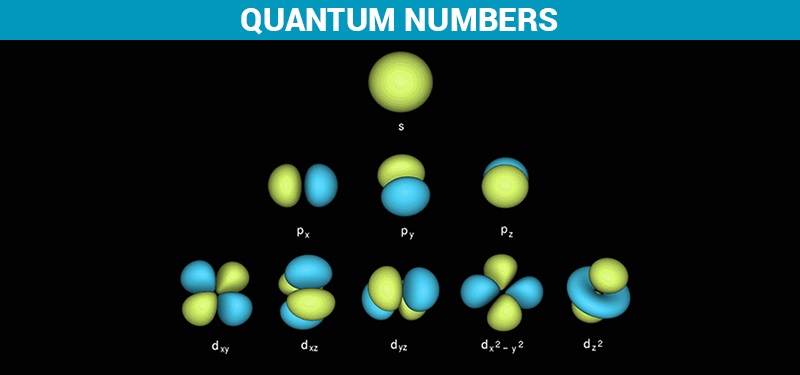
Quantum Numbers

Quantum Numbers and Atomic Orbitals

Four quantum numbers can be used to completely describe all the attributes of a given electron belonging to an atom, these are:

  • Principal quantum number, denoted by n.
  • Orbital angular momentum quantum number (or azimuthal quantum number), denoted by l.
  • Magnetic quantum number, denoted by ml.
  • The electron spin quantum number, denoted by ms.
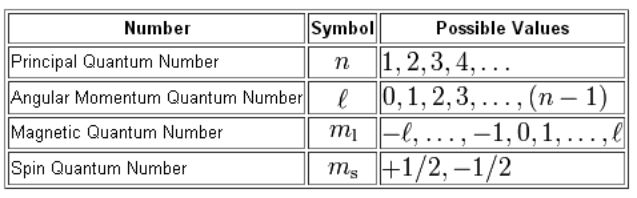
Electronic Quantum Numbers

The Four Quantum Numbers that Describe an Electron

Recommended Videos
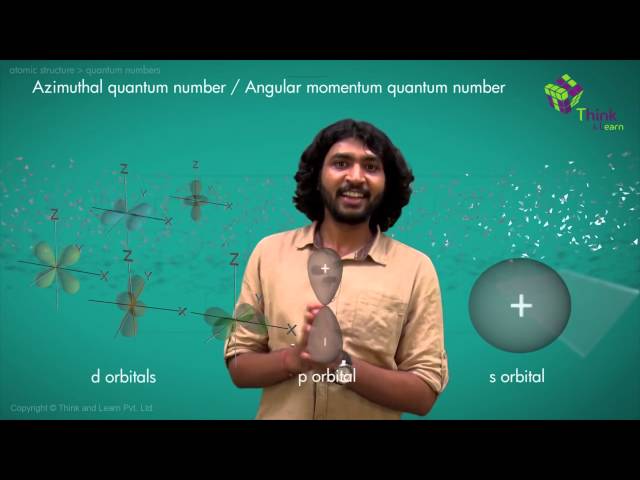

When the characteristics of an electron must be described in compliance with the Schrodinger wave equation, a total of four quantum numbers are used. A brief description of each of these numbers in the set of four quantum numbers that describe the unique quantum state of an electron in atomic physics can be found below.

Principal Quantum Number

  • Principal quantum numbers are denoted by the symbol ‘n’. They designate the principal electron shell of the atom. Since the most probable distance between the nucleus and the electrons is described by it, a larger value of the principal quantum number implies a greater distance between the electron and the nucleus (which, in turn, implies a greater atomic size).
  • The value of the principal quantum number can be any integer with a positive value that is equal to or greater than one. The value n=1 denotes the innermost electron shell of an atom, which corresponds to the lowest energy state (or the ground state) of an electron.
  • Thus, it can be understood that the principal quantum number, n, cannot have a negative value or be equal to zero because it is not possible for an atom to have a negative value or no value for a principal shell.
  • When a given electron is infused with energy (excited state), it can be observed that the electron jumps from one principle shell to a higher shell, causing an increase in the value of n. Similarly, when electrons lose energy, they jump back into lower shells and the value of n also decreases.
  • The increase in the value of n for an electron is called absorption, emphasizing the photons or energy being absorbed by the electron. Similarly, the decrease in the value of n for an electron is called emission, where the electrons emit their energy.

Azimuthal Quantum Number (Orbital Angular Momentum Quantum Number)

  • The azimuthal (or orbital angular momentum) quantum number describes the shape of a given orbital. It is denoted by the symbol ‘l’ and its value is equal to the total number of angular nodes in the orbital.
  • A value of the azimuthal quantum number can indicate either an s, p, d, or f subshell which vary in shapes. This value depends on (and is capped by) the value of the principal quantum number, i.e. the value of the azimuthal quantum number ranges between 0 and (n-1).
  • For example, if n =3, the azimuthal quantum number can take on the following values – 0,1, and 2. When l=0, the resulting subshell is an ‘s’ subshell. Similarly, when l=1 and l=2, the resulting subshells are ‘p’ and ‘d’ subshells (respectively). Therefore, when n=3, the three possible subshells are 3s, 3p, and 3d.
  • In another example where the value of n is 5, the possible values of l are 0, 1, 2, 3, and 4. If l = 3, then there are a total of three angular nodes in the atom.
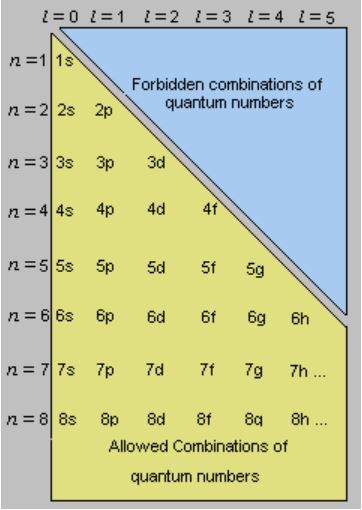
    Combinations of the Principal and Azimuthal Quantum Numbers

    Combinations of the Principal and Azimuthal Quantum Numbers

The allowed subshells under different combinations of ‘n’ and ‘l’ are listed above. It can be understood that the ‘2d’ orbital cannot exist since the value of ‘l’ is always less than that of ‘n’.

Magnetic Quantum Number

The total number of orbitals in a subshell and the orientation of these orbitals are determined by the magnetic quantum number. It is denoted by the symbol ‘ml’. This number yields the projection of the angular momentum corresponding to the orbital along a given axis.
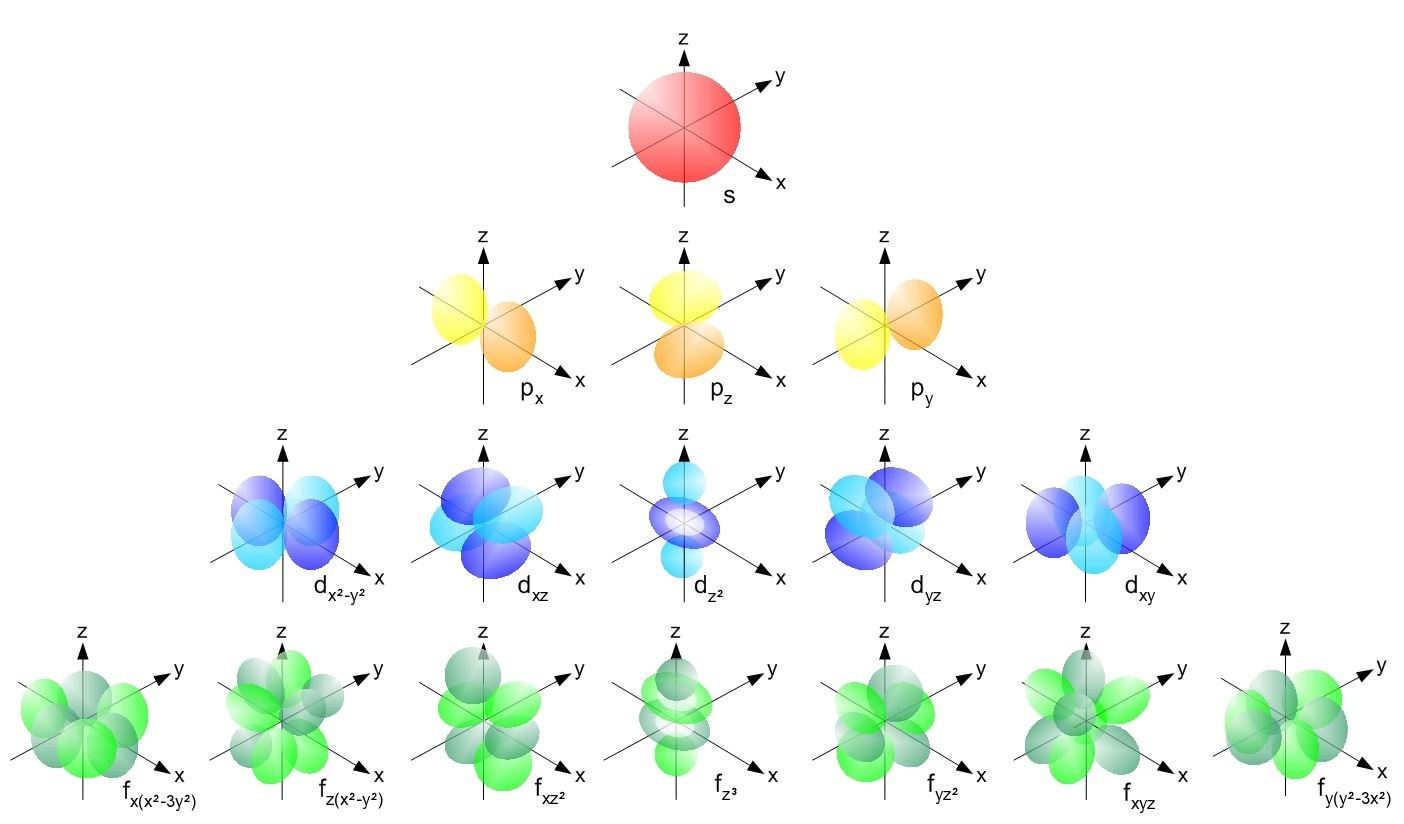
Orbitals as per Quantum Numbers

Shapes of Orbitals (as per the corresponding Quantum Numbers)

The value of the magnetic quantum number is dependant on the value of the azimuthal (or orbital angular momentum) quantum number. For a given value of l, the value of ml ranges between the interval -l to +l. Therefore, it indirectly depends on the value of n.

For example, if n = 4 and l = 3 in an atom, the possible values of the magnetic quantum number are -3, -2, -1, 0, +1, +2, and +3.

Azimuthal Quantum Number ValueCorresponding Number of Orbitals (2l + 1)Possible Values of ml
0 (‘s’ subshell)2*0 + 1 = 10
1 (‘p’ subshell)2*1 + 1 = 3-1, 0, and 1
2 (‘d’ subshell)2*2 + 1 = 5-2, -1, 0, 1, and 2
3 (‘f’ subshell)2*3 + 1 = 7-3, -2, -1, 0, 1, 2, and 3

The total number of orbitals in a given subshell is a function of the ‘l’ value of that orbital. It is given by the formula (2l + 1). For example, the ‘3d’ subshell (n=3, l=2) contains 5 orbitals (2*2 + 1). Each orbital can accommodate 2 electrons. Therefore, the 3d subshell can hold a total of 10 electrons.

Electron Spin Quantum Number

  • The electron spin quantum number is independent of the values of n, l, and ml. The value of this number gives insight into the direction in which the electron is spinning, and is denoted by the symbol ms.
  • The value of ms offers insight into the direction in which the electron is spinning. The possible values of the electron spin quantum number are +½ and -½.
  • The positive value of ms implies an upward spin on the electron which is also called ‘spin up’ and is denoted by the symbol ↑. If ms has a negative value, the electron in question is said to have a downward spin, or a ‘spin down’, which is given by the symbol ↓.
  • The value of the electron spin quantum number determines whether the atom in question has the ability to produce a magnetic field. The value of ms can be generalized to ±½.

Summary

In order to simplify the details of the four different quantum numbers that are related to atomic physics, a tabular column detailing their names, symbols, meanings, and possible values is provided below.

Name and SymbolMeaning and Possible Values
Principal quantum number, nElectron shell, n ≥ 1
Azimuthal quantum number, lSubshells (s=0, p=1, etc.) , (n-1) ≥ l ≥ 0
Magnetic quantum number, mlTotal number and orientation of orbitals, l≥ml≥-l
Electron spin quantum number, msThe direction of electron spin, ms = ±½

It is important to note that it is impossible for two electrons of the same atom to have exactly the same quantum state or exactly the same values of the set of quantum numbers, as per Hund’s rules.

Solved Examples

What are the Possible Subshells when n = 4? How Many Orbitals are Contained by Each of these Subshells?

When n = 4, the possible l values are 0, 1, 2, and 3. This implies that the 4 possible subshells are the 4s, 4p, 4d, and 4f subshells.

  • The 4s subshell contains 1 orbital and can hold up to 2 electrons.
  • The 4p subshell contains 3 orbitals and can hold up to 6 electrons.
  • The 4d subshell contains 5 orbitals and can hold up to 10 electrons.
  • The 4f subshell has 7 orbitals and can hold up to 14 electrons.

Thus, a total of 4 subshells are possible for n = 4.

What are the Possible ml values for l = 4?

Since the value of the magnetic quantum number ranges from -l to l, the possible values of ml when l = 4 are: -4, -3, -2, -1, 0, 1, 2, 3, and 4.

Frequently Asked Questions – FAQs

Who proposed the principal quantum number?

The notion of energy levels and notation has been taken from the atom ‘s earlier Bohr model. Schrodinger ‘s equation evolved the concept from a two-dimensional flat Bohr atom to a three-dimensional model for wave motion. Where n = 1 , 2 , 3 is called the main quantity, and h is the constant of Planck.

Why are there only 8 electrons in the outer shell?

The stability of an atom ‘s eight-electrons derives from the stability of the noble gases or the elder term of inert gases, also known as unreactive or noble gases. This law, however, is justified in the periodic table for second row elements whose outermost-shell capacity is 8 electrons.

How do you find the principal quantum number?

The principal quantum number n value is the level of the central electronic shell (central level). All orbitals with the same n value are at the same key stage. All orbitals on the second main stage , for example, have a principal quantity of n=2.

What are the principal energy levels?

In chemistry, an electron’s primary energy level refers to the shell or orbital in which the electron resides relative to the nucleus of the atom. The principal quantum number n denotes this level. Within a time of the periodic table the first element introduces a new key energy level.

Which energy level has the least energy?

There is a single 1s orbital that can accommodate 2 electrons at the lowest energy level, the one nearest to the atomic core. There are four orbitals at the next energy level; a 2s, 2p1, 2p2 and a 2p3. Each of these orbitals can carry 2 electrons, so we can find a total of 8 electrons at this energy level.

What is Quantum Energy?

Quantum, in mechanics, of energy, charge, angular momentum, or other physical property, discrete natural unit, or bundle. Photons, a concept often applied to quanta with other sources of electromagnetic radiation such as X rays and gamma rays, are certain particle-like packets of light.

What is magnetic Polarisation?

The vector field that represents the density of permanent or induced magnetic dipole moments in a magnetic medium is magnetization or magnetic polarisation in classical electromagnetism. A pseudovector M is represented.

What is the spin of an electron?

A quantum property of electrons is electron spin. It is an angular momentum shape. Instructors also equate electron spin to the planet rotating on its own axis every 24 hours as a teaching technique. If the electron spins on its axis clockwise, it is known as spin-up; spin-down is counterclockwise.

To learn more about quantum numbers and their uses in writing electron configurations, download the ANAND CLASSES mobile application on your smartphone.

Tuesday, 2 February 2021

Quantum Numbers (Principal, Azimuthal, Magnetic & Spin) - Definition, Detailed Explanation with Videos

Table of Contents

What are Quantum NumbersRecommended VideosPrincipal Quantum NumberAzimuthal Quantum NumberMagnetic Quantum NumberElectron Spin Quantum NumberSummary

Quantum numbers can be used to describe the trajectory and the movement of an electron in an atom. The quantum numbers of all the electrons in a given atom, when combined, must comply with the Schrodinger equation.

What are Quantum Numbers?

The set of numbers used to describe the position and energy of the electron in an atom are called quantum numbers. There are four quantum numbers, namely, principal, azimuthal, magnetic and spin quantum numbers.

The values of the conserved quantities of a quantum system are given by quantum numbers. Electronic quantum numbers (the quantum numbers describing electrons) can be defined as a group of numerical values which provide solutions that are acceptable by the Schrodinger wave equation for hydrogen atoms.

Quantum Numbers

Quantum Numbers and Atomic Orbitals

Four quantum numbers can be used to completely describe all the attributes of a given electron belonging to an atom, these are:

  • Principal quantum number, denoted by n.
  • Orbital angular momentum quantum number (or azimuthal quantum number), denoted by l.
  • Magnetic quantum number, denoted by ml.
  • The electron spin quantum number, denoted by ms.
Electronic Quantum Numbers

The Four Quantum Numbers that Describe an Electron

Recommended Videos


When the characteristics of an electron must be described in compliance with the Schrodinger wave equation, a total of four quantum numbers are used. A brief description of each of these numbers in the set of four quantum numbers that describe the unique quantum state of an electron in atomic physics can be found below.

Principal Quantum Number

  • Principal quantum numbers are denoted by the symbol ‘n’. They designate the principal electron shell of the atom. Since the most probable distance between the nucleus and the electrons is described by it, a larger value of the principal quantum number implies a greater distance between the electron and the nucleus (which, in turn, implies a greater atomic size).
  • The value of the principal quantum number can be any integer with a positive value that is equal to or greater than one. The value n=1 denotes the innermost electron shell of an atom, which corresponds to the lowest energy state (or the ground state) of an electron.
  • Thus, it can be understood that the principal quantum number, n, cannot have a negative value or be equal to zero because it is not possible for an atom to have a negative value or no value for a principal shell.
  • When a given electron is infused with energy (excited state), it can be observed that the electron jumps from one principle shell to a higher shell, causing an increase in the value of n. Similarly, when electrons lose energy, they jump back into lower shells and the value of n also decreases.
  • The increase in the value of n for an electron is called absorption, emphasizing the photons or energy being absorbed by the electron. Similarly, the decrease in the value of n for an electron is called emission, where the electrons emit their energy.

Azimuthal Quantum Number (Orbital Angular Momentum Quantum Number)

  • The azimuthal (or orbital angular momentum) quantum number describes the shape of a given orbital. It is denoted by the symbol ‘l’ and its value is equal to the total number of angular nodes in the orbital.
  • A value of the azimuthal quantum number can indicate either an s, p, d, or f subshell which vary in shapes. This value depends on (and is capped by) the value of the principal quantum number, i.e. the value of the azimuthal quantum number ranges between 0 and (n-1).
  • For example, if n =3, the azimuthal quantum number can take on the following values – 0,1, and 2. When l=0, the resulting subshell is an ‘s’ subshell. Similarly, when l=1 and l=2, the resulting subshells are ‘p’ and ‘d’ subshells (respectively). Therefore, when n=3, the three possible subshells are 3s, 3p, and 3d.
  • In another example where the value of n is 5, the possible values of l are 0, 1, 2, 3, and 4. If l = 3, then there are a total of three angular nodes in the atom.
    Combinations of the Principal and Azimuthal Quantum Numbers

    Combinations of the Principal and Azimuthal Quantum Numbers

The allowed subshells under different combinations of ‘n’ and ‘l’ are listed above. It can be understood that the ‘2d’ orbital cannot exist since the value of ‘l’ is always less than that of ‘n’.

Magnetic Quantum Number

The total number of orbitals in a subshell and the orientation of these orbitals are determined by the magnetic quantum number. It is denoted by the symbol ‘ml’. This number yields the projection of the angular momentum corresponding to the orbital along a given axis.

Orbitals as per Quantum Numbers

Shapes of Orbitals (as per the corresponding Quantum Numbers)

The value of the magnetic quantum number is dependant on the value of the azimuthal (or orbital angular momentum) quantum number. For a given value of l, the value of ml ranges between the interval -l to +l. Therefore, it indirectly depends on the value of n.

For example, if n = 4 and l = 3 in an atom, the possible values of the magnetic quantum number are -3, -2, -1, 0, +1, +2, and +3.

Azimuthal Quantum Number ValueCorresponding Number of Orbitals (2l + 1)Possible Values of ml
0 (‘s’ subshell)2*0 + 1 = 10
1 (‘p’ subshell)2*1 + 1 = 3-1, 0, and 1
2 (‘d’ subshell)2*2 + 1 = 5-2, -1, 0, 1, and 2
3 (‘f’ subshell)2*3 + 1 = 7-3, -2, -1, 0, 1, 2, and 3

The total number of orbitals in a given subshell is a function of the ‘l’ value of that orbital. It is given by the formula (2l + 1). For example, the ‘3d’ subshell (n=3, l=2) contains 5 orbitals (2*2 + 1). Each orbital can accommodate 2 electrons. Therefore, the 3d subshell can hold a total of 10 electrons.

Electron Spin Quantum Number

  • The electron spin quantum number is independent of the values of n, l, and ml. The value of this number gives insight into the direction in which the electron is spinning, and is denoted by the symbol ms.
  • The value of ms offers insight into the direction in which the electron is spinning. The possible values of the electron spin quantum number are +½ and -½.
  • The positive value of ms implies an upward spin on the electron which is also called ‘spin up’ and is denoted by the symbol ↑. If ms has a negative value, the electron in question is said to have a downward spin, or a ‘spin down’, which is given by the symbol ↓.
  • The value of the electron spin quantum number determines whether the atom in question has the ability to produce a magnetic field. The value of ms can be generalized to ±½.

Summary

In order to simplify the details of the four different quantum numbers that are related to atomic physics, a tabular column detailing their names, symbols, meanings, and possible values is provided below.

Name and SymbolMeaning and Possible Values
Principal quantum number, nElectron shell, n ≥ 1
Azimuthal quantum number, lSubshells (s=0, p=1, etc.) , (n-1) ≥ l ≥ 0
Magnetic quantum number, mlTotal number and orientation of orbitals, l≥ml≥-l
Electron spin quantum number, msThe direction of electron spin, ms = ±½

It is important to note that it is impossible for two electrons of the same atom to have exactly the same quantum state or exactly the same values of the set of quantum numbers, as per Hund’s rules.

Solved Examples

What are the Possible Subshells when n = 4? How Many Orbitals are Contained by Each of these Subshells?

When n = 4, the possible l values are 0, 1, 2, and 3. This implies that the 4 possible subshells are the 4s, 4p, 4d, and 4f subshells.

  • The 4s subshell contains 1 orbital and can hold up to 2 electrons.
  • The 4p subshell contains 3 orbitals and can hold up to 6 electrons.
  • The 4d subshell contains 5 orbitals and can hold up to 10 electrons.
  • The 4f subshell has 7 orbitals and can hold up to 14 electrons.

Thus, a total of 4 subshells are possible for n = 4.

What are the Possible ml values for l = 4?

Since the value of the magnetic quantum number ranges from -l to l, the possible values of ml when l = 4 are: -4, -3, -2, -1, 0, 1, 2, 3, and 4.

Frequently Asked Questions – FAQs

Who proposed the principal quantum number?

The notion of energy levels and notation has been taken from the atom ‘s earlier Bohr model. Schrodinger ‘s equation evolved the concept from a two-dimensional flat Bohr atom to a three-dimensional model for wave motion. Where n = 1 , 2 , 3 is called the main quantity, and h is the constant of Planck.

Why are there only 8 electrons in the outer shell?

The stability of an atom ‘s eight-electrons derives from the stability of the noble gases or the elder term of inert gases, also known as unreactive or noble gases. This law, however, is justified in the periodic table for second row elements whose outermost-shell capacity is 8 electrons.

How do you find the principal quantum number?

The principal quantum number n value is the level of the central electronic shell (central level). All orbitals with the same n value are at the same key stage. All orbitals on the second main stage , for example, have a principal quantity of n=2.

What are the principal energy levels?

In chemistry, an electron’s primary energy level refers to the shell or orbital in which the electron resides relative to the nucleus of the atom. The principal quantum number n denotes this level. Within a time of the periodic table the first element introduces a new key energy level.

Which energy level has the least energy?

There is a single 1s orbital that can accommodate 2 electrons at the lowest energy level, the one nearest to the atomic core. There are four orbitals at the next energy level; a 2s, 2p1, 2p2 and a 2p3. Each of these orbitals can carry 2 electrons, so we can find a total of 8 electrons at this energy level.

What is Quantum Energy?

Quantum, in mechanics, of energy, charge, angular momentum, or other physical property, discrete natural unit, or bundle. Photons, a concept often applied to quanta with other sources of electromagnetic radiation such as X rays and gamma rays, are certain particle-like packets of light.

What is magnetic Polarisation?

The vector field that represents the density of permanent or induced magnetic dipole moments in a magnetic medium is magnetization or magnetic polarisation in classical electromagnetism. A pseudovector M is represented.

What is the spin of an electron?

A quantum property of electrons is electron spin. It is an angular momentum shape. Instructors also equate electron spin to the planet rotating on its own axis every 24 hours as a teaching technique. If the electron spins on its axis clockwise, it is known as spin-up; spin-down is counterclockwise.

To learn more about quantum numbers and their uses in writing electron configurations, download the ANAND CLASSES mobile application on your smartphone.

Monday, 1 February 2021

Sainik School GK MCQs|@9463138669|Sainik School Coaching|Anand Classes

CALL 9463138669, ANAND CLASSES–ALL INDIA SAINIK SCHOOL ENTRANCE EXAM COACHING CENTER IN JALANDHAR.

Revision Course : Sainik School Exam Syllabus (Topic Wise GK)Sainik School GK MCQs. Sainik School Coaching Jalandhar. RIMC RMS Coaching Jalandhar. Sainik School Coaching Jalandhar. Sainik School Exam Study Material 

We, at ANAND CLASSES, are providing the Study Material for All India Sainik School Entrance Exam  for students who want to excel in their studies and ace their final exam.

SET-1


Question No (1) What is the full form of CBSE?
Answer: Central Board of Secondary Education.

Question No (2) Prime Minister of India ‘Narendra Modi’ born on which date?
Answer: 17 September 1950.

Question No (3) Which country produce higher amount of Black pepper in the world?
Answer: Vietnam.

Question No (4) The Red Fort is located at where in India?
Answer: Delhi.

Question No (5) Udaipur is famous city in which state of India?
Answer: Rajasthan.

Question No (6) Indira Gandhi born in which year?
Answer: 1917.

Question No (7) Where is the ‘Mount Abu’ in India?
Answer: Rajshthan State.

Question No (8) Taj Mahal is also known as which name?
Answer: Crown Palace.

Question No (9) Where is ‘Pangong Lake’ (also known as Pangong Tso) in India?
Answer: Ladakh.

Question No (10) Where is Jama Masjid in India?
Answer: Delhi.


Question No (11) Dr Bhim Rao Ambedkar is know as ___ of Indian Constitution?
Answer: Father. Online Sainik School Coaching

Question No (12) Hawa Mahal is located in which state of India?
Answer: Rajasthan. Online Sainik School Coaching

Question No (13) What is the full form of IRCTC?
Answer: Indian Railways Catering and Tourism Corporation. Online Sainik School Coaching

Question No (14) Temple of Badrinath is located in which state of India?
Answer: Uttarakhand (Chamoli district).

Question No (15) Jantar Mantar (New Delhi) was founded by whom?
Answer: Maharaja Jai Singh II. Online Sainik School Coaching

Question No (16) Mouse is ___ device in computer system?
Answer: Input.

Question No (17) World War II ended in which year?
Answer: 1945.

Question No (18) Rose is the flowering plant comes under which family?
Answer: Rosaceae family.

Question No (19) How many colors are there in a Rambo?
Answer: Seven.

Question No (20) Nokia is which type of company?
Answer: Telecommunications company.


Question No (21) What is the reason for high heat of the sun?
Answer: Nuclear fusion of hydrogen.

Question No (22) Netaji Subhash Chandra Bose International Airport is in which city?
Answer: Kolkata.

Question No (23) Why does the snow float on the water?
Answer: Due to less density than water. RIMC RMS Coaching Jalandhar

Question No (24) Ozan layer protects the earth from whom?
Answer: Space and other radiation. RIMC RMS Coaching Jalandhar

Question No (25) Which game is related to the Ranji Trophy?
Answer: Cricket.

Sainik School Coaching Jalandhar|Shape of Earth & Gravitation|Anand Classes|@9463138669|

Scientific Devices Used in Daily Life|Sainik School Exam|@9463138669|Anand Classes


RIMC RMS Coaching Jalandhar

Quantum Numbers (Principal, Azimuthal, Magnetic & Spin) - Definition, Detailed Explanation with Videos

Table of Contents

What are Quantum NumbersRecommended VideosPrincipal Quantum NumberAzimuthal Quantum NumberMagnetic Quantum NumberElectron Spin Quantum NumberSummary

Quantum numbers can be used to describe the trajectory and the movement of an electron in an atom. The quantum numbers of all the electrons in a given atom, when combined, must comply with the Schrodinger equation.

What are Quantum Numbers?

The set of numbers used to describe the position and energy of the electron in an atom are called quantum numbers. There are four quantum numbers, namely, principal, azimuthal, magnetic and spin quantum numbers.

The values of the conserved quantities of a quantum system are given by quantum numbers. Electronic quantum numbers (the quantum numbers describing electrons) can be defined as a group of numerical values which provide solutions that are acceptable by the Schrodinger wave equation for hydrogen atoms.

Quantum Numbers

Quantum Numbers and Atomic Orbitals

Four quantum numbers can be used to completely describe all the attributes of a given electron belonging to an atom, these are:

  • Principal quantum number, denoted by n.
  • Orbital angular momentum quantum number (or azimuthal quantum number), denoted by l.
  • Magnetic quantum number, denoted by ml.
  • The electron spin quantum number, denoted by ms.
Electronic Quantum Numbers

The Four Quantum Numbers that Describe an Electron

Recommended Videos


When the characteristics of an electron must be described in compliance with the Schrodinger wave equation, a total of four quantum numbers are used. A brief description of each of these numbers in the set of four quantum numbers that describe the unique quantum state of an electron in atomic physics can be found below.

Principal Quantum Number

  • Principal quantum numbers are denoted by the symbol ‘n’. They designate the principal electron shell of the atom. Since the most probable distance between the nucleus and the electrons is described by it, a larger value of the principal quantum number implies a greater distance between the electron and the nucleus (which, in turn, implies a greater atomic size).
  • The value of the principal quantum number can be any integer with a positive value that is equal to or greater than one. The value n=1 denotes the innermost electron shell of an atom, which corresponds to the lowest energy state (or the ground state) of an electron.
  • Thus, it can be understood that the principal quantum number, n, cannot have a negative value or be equal to zero because it is not possible for an atom to have a negative value or no value for a principal shell.
  • When a given electron is infused with energy (excited state), it can be observed that the electron jumps from one principle shell to a higher shell, causing an increase in the value of n. Similarly, when electrons lose energy, they jump back into lower shells and the value of n also decreases.
  • The increase in the value of n for an electron is called absorption, emphasizing the photons or energy being absorbed by the electron. Similarly, the decrease in the value of n for an electron is called emission, where the electrons emit their energy.

Azimuthal Quantum Number (Orbital Angular Momentum Quantum Number)

  • The azimuthal (or orbital angular momentum) quantum number describes the shape of a given orbital. It is denoted by the symbol ‘l’ and its value is equal to the total number of angular nodes in the orbital.
  • A value of the azimuthal quantum number can indicate either an s, p, d, or f subshell which vary in shapes. This value depends on (and is capped by) the value of the principal quantum number, i.e. the value of the azimuthal quantum number ranges between 0 and (n-1).
  • For example, if n =3, the azimuthal quantum number can take on the following values – 0,1, and 2. When l=0, the resulting subshell is an ‘s’ subshell. Similarly, when l=1 and l=2, the resulting subshells are ‘p’ and ‘d’ subshells (respectively). Therefore, when n=3, the three possible subshells are 3s, 3p, and 3d.
  • In another example where the value of n is 5, the possible values of l are 0, 1, 2, 3, and 4. If l = 3, then there are a total of three angular nodes in the atom.
    Combinations of the Principal and Azimuthal Quantum Numbers

    Combinations of the Principal and Azimuthal Quantum Numbers

The allowed subshells under different combinations of ‘n’ and ‘l’ are listed above. It can be understood that the ‘2d’ orbital cannot exist since the value of ‘l’ is always less than that of ‘n’.

Magnetic Quantum Number

The total number of orbitals in a subshell and the orientation of these orbitals are determined by the magnetic quantum number. It is denoted by the symbol ‘ml’. This number yields the projection of the angular momentum corresponding to the orbital along a given axis.

Orbitals as per Quantum Numbers

Shapes of Orbitals (as per the corresponding Quantum Numbers)

The value of the magnetic quantum number is dependant on the value of the azimuthal (or orbital angular momentum) quantum number. For a given value of l, the value of ml ranges between the interval -l to +l. Therefore, it indirectly depends on the value of n.

For example, if n = 4 and l = 3 in an atom, the possible values of the magnetic quantum number are -3, -2, -1, 0, +1, +2, and +3.

Azimuthal Quantum Number ValueCorresponding Number of Orbitals (2l + 1)Possible Values of ml
0 (‘s’ subshell)2*0 + 1 = 10
1 (‘p’ subshell)2*1 + 1 = 3-1, 0, and 1
2 (‘d’ subshell)2*2 + 1 = 5-2, -1, 0, 1, and 2
3 (‘f’ subshell)2*3 + 1 = 7-3, -2, -1, 0, 1, 2, and 3

The total number of orbitals in a given subshell is a function of the ‘l’ value of that orbital. It is given by the formula (2l + 1). For example, the ‘3d’ subshell (n=3, l=2) contains 5 orbitals (2*2 + 1). Each orbital can accommodate 2 electrons. Therefore, the 3d subshell can hold a total of 10 electrons.

Electron Spin Quantum Number

  • The electron spin quantum number is independent of the values of n, l, and ml. The value of this number gives insight into the direction in which the electron is spinning, and is denoted by the symbol ms.
  • The value of ms offers insight into the direction in which the electron is spinning. The possible values of the electron spin quantum number are +½ and -½.
  • The positive value of ms implies an upward spin on the electron which is also called ‘spin up’ and is denoted by the symbol ↑. If ms has a negative value, the electron in question is said to have a downward spin, or a ‘spin down’, which is given by the symbol ↓.
  • The value of the electron spin quantum number determines whether the atom in question has the ability to produce a magnetic field. The value of ms can be generalized to ±½.

Summary

In order to simplify the details of the four different quantum numbers that are related to atomic physics, a tabular column detailing their names, symbols, meanings, and possible values is provided below.

Name and SymbolMeaning and Possible Values
Principal quantum number, nElectron shell, n ≥ 1
Azimuthal quantum number, lSubshells (s=0, p=1, etc.) , (n-1) ≥ l ≥ 0
Magnetic quantum number, mlTotal number and orientation of orbitals, l≥ml≥-l
Electron spin quantum number, msThe direction of electron spin, ms = ±½

It is important to note that it is impossible for two electrons of the same atom to have exactly the same quantum state or exactly the same values of the set of quantum numbers, as per Hund’s rules.

Solved Examples

What are the Possible Subshells when n = 4? How Many Orbitals are Contained by Each of these Subshells?

When n = 4, the possible l values are 0, 1, 2, and 3. This implies that the 4 possible subshells are the 4s, 4p, 4d, and 4f subshells.

  • The 4s subshell contains 1 orbital and can hold up to 2 electrons.
  • The 4p subshell contains 3 orbitals and can hold up to 6 electrons.
  • The 4d subshell contains 5 orbitals and can hold up to 10 electrons.
  • The 4f subshell has 7 orbitals and can hold up to 14 electrons.

Thus, a total of 4 subshells are possible for n = 4.

What are the Possible ml values for l = 4?

Since the value of the magnetic quantum number ranges from -l to l, the possible values of ml when l = 4 are: -4, -3, -2, -1, 0, 1, 2, 3, and 4.

Frequently Asked Questions – FAQs

Who proposed the principal quantum number?

The notion of energy levels and notation has been taken from the atom ‘s earlier Bohr model. Schrodinger ‘s equation evolved the concept from a two-dimensional flat Bohr atom to a three-dimensional model for wave motion. Where n = 1 , 2 , 3 is called the main quantity, and h is the constant of Planck.

Why are there only 8 electrons in the outer shell?

The stability of an atom ‘s eight-electrons derives from the stability of the noble gases or the elder term of inert gases, also known as unreactive or noble gases. This law, however, is justified in the periodic table for second row elements whose outermost-shell capacity is 8 electrons.

How do you find the principal quantum number?

The principal quantum number n value is the level of the central electronic shell (central level). All orbitals with the same n value are at the same key stage. All orbitals on the second main stage , for example, have a principal quantity of n=2.

What are the principal energy levels?

In chemistry, an electron’s primary energy level refers to the shell or orbital in which the electron resides relative to the nucleus of the atom. The principal quantum number n denotes this level. Within a time of the periodic table the first element introduces a new key energy level.

Which energy level has the least energy?

There is a single 1s orbital that can accommodate 2 electrons at the lowest energy level, the one nearest to the atomic core. There are four orbitals at the next energy level; a 2s, 2p1, 2p2 and a 2p3. Each of these orbitals can carry 2 electrons, so we can find a total of 8 electrons at this energy level.

What is Quantum Energy?

Quantum, in mechanics, of energy, charge, angular momentum, or other physical property, discrete natural unit, or bundle. Photons, a concept often applied to quanta with other sources of electromagnetic radiation such as X rays and gamma rays, are certain particle-like packets of light.

What is magnetic Polarisation?

The vector field that represents the density of permanent or induced magnetic dipole moments in a magnetic medium is magnetization or magnetic polarisation in classical electromagnetism. A pseudovector M is represented.

What is the spin of an electron?

A quantum property of electrons is electron spin. It is an angular momentum shape. Instructors also equate electron spin to the planet rotating on its own axis every 24 hours as a teaching technique. If the electron spins on its axis clockwise, it is known as spin-up; spin-down is counterclockwise.

To learn more about quantum numbers and their uses in writing electron configurations, download the ANAND CLASSES mobile application on your smartphone.